Ontology and Prayer – Entering God’s Court

or How to Make a Simple Topic Everyone Knows Really Amazingly Boring

IMG_2216

As a priest of the church and a pastor I have the spiritual gift of obfuscation.  I can take the most amazingly simple thing that anyone already has deep experience of and make it long, dry, and almost incomprehensible.  It is really impressive to watch.  I can use long words for common ideas.  Where one syllable will do I can use forty.  I can craft sentences of Pauline length with neither clarity nor purpose but that make you feel like you have heard something both understandable and meaningful when really you’ve just heard me blowing wind with no Spirit.

I try not to use this gift.  But as we come to the third part of our Trinity of Formation I want to be clear and concise and understandable.  I want to, but the topic lends itself to poetic philosophy, and I like the sound of words.

In our Anglican-Benedictine model, we have looked at the Office and the Eucharist, Father and Son.  They both demand submission in a way: Office to the universal praise of the Church Universal and to the Father’s world; the Eucharist to the community of royal heirs priesthood and the Reality of the Rule of God.  We turn now to the Spirit and prayer.

The Holy Spirit is described analogically as breath or wind.  It is this ethereal quality that makes it hard to talk about with any clarity.  Add to that the Spirit and language about her is always feminine, and our tradition is very masculine dominated and therefore less fluent in the language of the feminine, and you begin to see why we just don’t have good words for the Spirit’s work.

I am personally frustrated by trying to read anything about the Holy Spirit because it falls into one of two camps.  There is the language that feels ungrounded in anything but emotion and built with fluff.  It is “airy” language and borders on feeling New Age, to use that hackneyed christian insult.  (I use the lowercase to designate a cultural but not faithful use of the adjective.) Writers who base all they have to say in experience and resort to stroking emotions and Chicken Soup for the Soul stories and reflections to the get across blunt unformed opinions that reflect both a lack of depth and Scripture.  It feels fake and shallow.  The christian section of your local bookstore is filled with this stuff.  It is little better than New Age writing except that Jesus is mentioned.

That sounds bitter, but this kind of writing and reflection almost pushed me out to the church.  When it passes for formation and teaching, it becomes destructive because it separates the disciple from reality and the Bible.  It shows up in every sector of the church, so I don’t want to point at Pentecostals, Evangelicals, or Catholics alone.  (Episcopalians tend not to publish much of this stuff, because when we want inspiration we turn to NPR apparently. See here.)  I know that it is inspirational to many people, but I really thought I had to leave the church to find real grounded thinking for a long time as a youth.

On the other hand, trying to read Moltmann’s The Spirit of Life is not the most soul-feeding work for most people.  It is good theology but grounded in a vocabulary of insiders.  The vast majority of work on the Spirit feels either ungrounded of buried in church jargon.  I say “vast majority” but what I mean is really not very much.

“Serious” theologians avoid the Spirit for the most part or say so little as to be useless.  See Tillich’s third book in his trinity.  Count the number of times he talks about the Spirit.  Even N. T. Wright, whom I read with relish and mustard like ballpark franks, says almost nothing about the Holy Spirit.

I have found a few resources that are worthwhile.  But mostly I end up flipping pretty fast when it comes to the Spirit, too.  So as a reader, I might have skipped something, but I also have come to understand.

It is hard to talk about the Spirit.  Jesus says that you can’t see where the wind comes from or where it goes in reference to the Spirit and Spiritual People in talking to Nicodemus.

In our formation model, the Spirit though is a whole lot easier to talk about.  The Spirit is freedom.  She breathes and moves like wind through the world creating, shaping, and giving life.

So in our prayer life, we come to the third leg of our practice, which is what most of us call prayer, or talking to God.  I want to give you a definition that is more poetic.  Prayer is letting the Spirit have you.  

I mean free prayer, mental prayer, prayer of the heart, however you want to talk about individual being in community with God.  It is far more than talking to God, but it includes just talking to God.  We enter the Spirit like we open our arms into the wind on the beach after a run.

We let God breathe into us in the Spirit.

That is prayer.  Paul uses very similar language.  The Spirit moves within us, in our spirits to pray and make new.

There is a whole lot of new science that points toward neuroplasticity, that our brains continue to grow and form new patters and pathways for neurological signals.  Many of us have the idea that our brains get certain patterns and get stuck in those patterns.  We got that idea from science, which assumed that nerves did not continue to grow or regrow after trauma.  Science was wrong.  Newer science shows conclusively that we can not only change neural pathways, but new neurons are being born and growing all the time.  This means that we continue to learn.

The Spirit is making us new as we allow the Spirit to create us through study and thought, but also through prayer when we let the Spirit move through us, teach us, and pray through us.  When we open the Bible, we are saying in essence, “Spirit, teach me.”  When we enter silence and let the Spirit breathe through us, we are saying, “Holy Spirit, make me.”

This is not airy language, it is Biblical and scientific!

In our model, it is also practical and individual.  It is practical because just as we submit to the church’s praise and community, we submit to the Spirit’s work within us and learn things more deeply than either praise or community can teach us.  It is where we internalize the work.  We take that formation into prayer and let it be worked on, or opposed.

The Holy Spirit does not only confirm but also sifts and discerns truth for us.  It is this discernment that is also vital.  While submission to the church in time and community is important to formation, so is learning to trust the voice of God speaking in the Spirit within you.  You are an individual and God works with individuals, as much as with the Church and church.

In this prayer there is tremendous freedom.  Martin Thornton makes the point in several places that this freedom in prayer is a balance to the submission of Office and Eucharist.   In the Anglican tradition we have Julian of Norwich and Margery of Kempe.   Both of these women had visions and writings that would be considered heresy, except that they weren’t.  Both were honored in their day and still hold their own as deep theological women of the church.  He credits this to the freedom offered in our tradition by having a solid foundation in the other two functions of formation and prayer.

So pray wildly.  Let the Spirit have you.

Before I end, let me say why ontology and Entering God’s Court.  The Spirit makes us human.  Our being (ontology) is contingent on our having been God-breathed clay.  When we let the Holy Spirit breathe in us and use us, we are returning or turning to our true being.  It is amazing to me that this work, while deeply individualistic in nature, actually turns us outward to the world and each other.  It should, therefore, make us better stewards of creation and more human in our relationships, responsible and relational, as well as worshipful and reverent.

The Spirit comes from the court of God, naturally, since the Spirit emanates or exists from God as God.  This reality is present to us, the court of God or heaven, as we enter the Spirit, or let the Spirit enter us.  This Reality as I wrote about in the last post should be present in the community gathered, but it is also available in prayer.  But that Reality puts us in communion with God and our neighbor.

The caveat is that we can get distorted and therefore misapprehend Reality.  We need a community to discern and hold that Reality with us and sometimes for us.  We need to be bold in our grasping the Kingdom and humble in submitting to God and the community of the Church.  That is why the Spirit is never spoken of possessively.  The Holy Spirit is never quite “my” Spirit.

I have written before about my life falling apart.  Its no secret that in seminary I fell to pieces and got put back together.  That process of healing is still where my language about the Spirit was formed.  For a couple of years, I did the Ashtanga Yoga primary series in my little room alone as an act of prayer and sweat.  There is nothing mysterious about the series; it was memorizable, involved my whole body, hard, and free.  Later it would be running or Crossfit.  But I would get to the end and lay in corpse pose, laying flat on my back, wrung out and calm.  My brain would finally be still, and I could feel God breathe through me.  It was a tangible experience of the Holy Spirit.  I would let the Spirit have me, and I would end up crying or laughing, integrating big ideas and just luxuriating in the shades of sunlight dancing through the leaves outside my window on the walls of my room.

The Spirit spoke so directly in those hours because I had broken everything that normally gets in the way.  These days I am trying to listen just as hard without having to destroy everything to hear.

Coming to the Table – Remembering Christ with your Family and Friends

IMG_1737

In our last reflection we considered the Office as it relates to the Father, Abba, as we join in the church’s worship.  It is the cornerstone of the Anglican-Benedictine way of forming disciples.  I know that is counter-intuitive for Episcopalians and other liturgical churches.  We handed daily faithfulness off to the evangelical world through our low-church brothers and sisters and then forgot after the liturgical revolution of the past forty years.

We elevated the Eucharist to the center of our common life and after the 1979 revision of the Book of Common Prayer, we made the Daily Office difficult and frustrating to use.  I wanted to learn the Office as a Baptist convert in the 1990’s.  I wanted to learn.  I was motivated.  AND I was educated.  My undergraduate degree was Creative Arts in Worship.  I read Dom Gregory Dix for fun.  And yet I was utterly frustrated by the 1979 BCP and started printing off daily prayers from the internet!

Church Publishing, if you are reading along, I would love a BCP-based Breviary that is formatted for Daily Prayer.  I don’t want something all that new.  I want a simple formatted Breviary.  I will do it.  Just call.

But that isn’t our focus today.  Let’s go back to the Eucharist.

The Eucharist is the “great thanksgiving” in Greek.  It is called Communion or the Mass or the Lord’s Supper, and it is at the center of our communal life.  I love the Eucharist.  Don’t let the first couple of paragraphs fool you.

The thing is that we are in a funny place recently where we are trying to use the Eucharist in order to welcome people into church.  And that is like meeting a new friend as a couple by inviting them into your bedroom.  The Eucharist is the most intimate thing that disciples do.

We follow Jesus.  Jesus had his disciples, and on his last free night before facing trials and ultimately death, he had a meal with them that was remembered as a Passover meal.  This meal was the place where he took bread and wine and gave it to his friends and fellow brothers and sisters, blessing them and giving instructions to share the meal together to remember him.

The Greek word for “to remember” is anamnesis.  Plato considered the act of remembering as the only way that one could experience the real world beyond forms.  This is not necessarily what Jesus had in mind, but the concept is helpful.  When we remember we are bringing the fullness of our master to mind.

IMG_1758

If Jesus and his teachings are our master or king, rabbi, lord, then we are subjects who are defined by the master.  The master is not a popular concept in American culture, so we have lost some direct implications of what this means for us.  I discovered these ideas looking at the archetypes around king images and monarchist cultures.  These ideas are evident out as you look at the Mediterranean and Biblical cultural studies and early Roman and Greek literature.

The king defines identity for the subject.  The king defines ethos.  The king defines relationships, ethics, ways of interacting, what is acceptable and what is not.  The king defines the world within the kingdom.  (I know this language is masculine, but it is the most common. It is true of queens too.)

The ruler defines the ruled.  This runs directly counter to our culture.  I know.  So as a disciple we come to remembrance to recall our salvation, but also to re-enter the world of our Maker and Master.  We re-enter the space where the kingdom is present, where we are children of God, in direct relationship as brothers and sisters provided for and forgiven, healed and set free to love others as we are loved by God.

To step into such a world together is renewing and helps to make us whole.  We hear the stories of our faith, pray as the priesthood family of God, and we remember our Lord in the meal and prayer that is the Eucharist.  It is our internal reality, the reality that we trust in and believe in as we walk in the world that does not agree with those statements or that reality.

It is this that creates the tension around the open table movement.  On the one hand, we are remembering Jesus whose messiahship was modeled in eating at the table with people from all different walks of life, a model that the church picked up and was persecuted for in the early centuries as much as the idea of cannibalism.  On the other, the Eucharist is a re-enactment of this final meal and has a component of remembrance that defines our reality.

At the very least the church should be honest about what we are doing for our members and for visitors.  But I have come to rest more and more uneasily with the movement to make our sacraments a portable portal for all comers.  I don’t think that they are actually being brought in with any real honesty or fidelity because on some level we don’t take what we are doing seriously or we don’t take their participation seriously.  They are being asked to enter a different reality and accept ethos, ethics, and relationships that they may not be ready to take on, may not understand, and may not really agree with if they did.

Outside of the reality that we are remembering our sacraments don’t really make much sense.  Paul said that if there was no resurrection then he was a fool.  I would hold the same thing about the play acting we are doing on Sundays.  If we are not re-entering that reality in an intentional and prayerful way that involves our whole self, then we are just fools playing at images.

We remember Jesus and re-member Christ as we take our parts in his body and in the family as the children of God.  This is amazing and wondrous.  It is mystery and meal all at once.

When we come prepared, we enter that reality with less dissonance and greater clarity, we leave with more work being done on us, and we go back into the world to carry that reality with us.  We prepare by joining in the ongoing universal prayers of the church daily in the Offices.  We know the stories of our faith more deeply.

Our minds are trained for prayer, praise, and petition.  Our hearts are trained for compassion and trust and forgiveness.  Our brains can focus more easily.  And we are free to come and go lightly into the world we live in intentionally daily, so we can greet our neighbors and love even in transition, and we are less thrown off by the incidentals of our lives and our church community.

In this way, the Office makes the Eucharist more readily available and our experience more communal.  When we have done our office work we can do our work at the table with more joy.

At this table we are not strangers but family.  We are not alone in the city but walking in the Garden with our God and our family.  We are provided for and forgiven.  We are loved and set free.  That is salvation in the flesh.  That is what we are trying to live into as we come to the table of God.

Come prepared and go home renewed.  Remembering who God is in Jesus, what the world will be and what the kingdom is, and who you are, who your neighbor is, and how blessed the whole thing is, we come back to the sixth day of the new creation to enter our Sabbath anew.

IMG_1703

Finding the Office – Worshipping the Father, Cuddling with Abba

Where I often keep the Office

Where I often keep the Office

The life of the Christian is trinitarian in nature, organically rooted around the Daily Office, Eucharist, and interior prayer.  These three are understood in the Benedictine tradition as the foundation of the acetic life.  Ascetical refers to the life of prayer and growth in the Spirit.

I have ranted in a recent sermon about how not everything is a “journey.” It seems like this phrase is usually a cover for being unwilling to progress.  In our life of faith, we should be growing up, going somewhere we call maturity.  Much of what we see in terms of “perfection” in the New Testament could just as easily be translated as “maturity” or “completion.”

In Martin Thornton’s picture of the influence of Benedict on English Spirituality, he sees the Office as the part of the life of the Christian and Church as particular to God the Father.  It is in the Office where we do our work of worship and showing up and growing up, taking up a practice that is beyond us and our opinions, where we deal with things that are often beyond us and even deeply challenging for us.

Worship is both the act of praising God, picture standing arms outstretched and smiling, and humbly coming into the presence for help, forgiveness, and petition, picture hands folded bowing.  It is the bringing of our fullness and placing it before God and remembering who is who.

The Office is great for worship because it is heavily Scriptural.  Coming out and condensing the Hours of the Rule of Benedict, it distills the worship of the Bible and relies on the Psalms and songs of Scripture and adds in the reading of the Bible in large chunks.  This word-heavy, passage-intense worship is laden with images, stories, and even words that are difficult and deal with emotions and work that we don’t necessarily want to deal with.  In the Office we submit to the work of becoming who God wants us to be.

Sometimes that is emotional work and totally relevant to the moment we are in.  I can’t tell you the number of times the Bible in Morning Prayer seems like it was written for the day I was in.  It is shocking.  Other times I can go for weeks just plugging along reading and praying the prayers because I said I would.

It is faithfulness even when my emotions are not there that really matters.  If I was only a faithful husband laying in bed on a Saturday mornings when the sun gently lighting the waking smile of my beautiful bride, but not when we fought or I was disappointed or bored . . . well I wouldn’t be able to call her my “wife” for very long.  Right?

Jesus uses two words for Father, Pater (Latin) or Abba (Aramaic).  The office is about submitting to both.  We submit to Abba, better translated as “daddy”, when we curl up in the lap of God as we pray, and we find that overwhelming sense of warmth and home.  We submit to Pater, Father, when we stick it out and allow ourselves to be shaped by the faithfulness of the long haul and stay on the road despite the boredom, ennui, and demands of the journey.

The Office is really simple.  I use a website or an app most of the time.  I have books and Bibles, which I prefer with time.  But I keep the Office, morning and night, and often in places where I have to be on my feet.

I will teach you the Office if you need it.  Email me.  Or I can place you with a coach.  We have several in the parish.  It matters.  As we explore the trinity of expression in our ascetical life, we begin with Benedict in the Office, being faithful.

In the Benedictine way the vows are obedience, stability, and transformation.  We meet all three vows in the practice of the Office.  In our faithful keeping of the hours, we are obedient to the larger worship of the church to God, we find stability amidst the changes of our days and emotions, and we are transformed to the likeness of our Father Abba.  We become stable enough to love, obedient enough to love even when difficult, and transformed in grace.

As a pastor I watch this play out in the lives of my parishioners and friends.  Their faithfulness in the practice becomes visible in their emotional, psychological health, their balance and theological understanding becomes a steady openness in debate possible with a sound foundation in the Bible and prayer.  They are more and more flexible and unshakeable as they grow.  I am in awe really of their growth.

Which brings a final point.  The Office is not clerical.  It belongs to the whole Church of which we collared ones are just members with jobs.  The liturgical movement has done some wonderful things for the Church universal, but for us it has meant the elevation of the Eucharist above the Office and interior prayer.  This has left us with a heart that depends of the clergy.  It has meant the rise of “fathers” and the diminishment of the faithful laity.  Keeping the Office in balance empowers the laity to take their rightful place as informed, formed followers of the Christ we worship and obey in the Eucharist.

*Notes:  The Book of Common Prayer Morning and Evening Prayers  are found between pages 75 – 126 in modern idiom.  The Daily Office lectionary readings are found on pages 931 and following.  The instructions are all in the BCP, but a coach or mentor or group is highly recommended.

As noted above I rely on the app and website offered by http://missionstclare.com . There are also very good sites out there and apps that I have used and relied on.  I use an iPhone, and there are several apps in the iOS store.  I would highly recommend the one offered by Forward Movement. I would never have been able to do the Office alone without Mission St. Clare’s website years ago.

How to Not Vote like an Idiot or a Fan

i-voted-sticker

I generally avoid politics other than to say that you probably shouldn’t vote like me.  I am a priest who believes that if I do my job as pastor, teacher, and preacher, then the congregations I serve will draw sound conclusions and vote from a conscience that is formed and informed by more than my simple point of view.

People of good faith may be led to radically different conclusions at the ballot box.  This confounds politicos and citizens alike, but it is vital to healthy democracy.

As a Christian and even more as a pastor and leader, I believe strongly that Christians should vote and be involved politically.  Think of it this way, for most of history the king or queen was seen to hold great authority and responsibility given because of their role in governing a portion of God’s kingdom.  Note that authority and responsibility went together.

A good Christian king could not feast while those in his care starved.  The victory gardens at the palaces of British nobles during the World Wars ought to stand in strong and disgusting contrast to our presidents’ vacations over the last thirteen years.  [And yes, that apostrophe is in the right place.]

We, of course, don’t have sovereigns.  We have citizens.  [We are ideally a Benedictine country, if you have been reading along.]  As citizens, we hold authority and responsibility like sovereigns of old.  Our primary place to practice those is in the ballot box.

So why is our citizenship so dumbed down that our presidents can call us “consumers” without an outcry?!  Because we often practice voting like idiots drug around by our media and public opinion disconnected from anything that could be considered value or virtue.  (Occasional outcries over the scandals of Instagram or freezers of money not withstanding, most of the media is playing our emotions not our values or virtues.)

Or worse, we becomes fans.  In the techisphere, fanboys are those people who love a product or product line because of the label on the back rather than the performance.  I am typing this on an Apple, by the way, while listening to my outdated iPhone.  Branding in politics may be breaking down, or at least we hope so.  But with the growth of money and advertising, we look more like people who know nothing being led by commercials rather than open debates about vital issues.

It is refreshing as an American to watch British parliamentary debates where the Prime Minister has to field questions from their colleagues on the floor rather than our president choosing who to answer from the press corps.  Genuine thought and responses, with wonderful hooting and name calling, but face to face and responsive.  (Swoon.)

So what is an American to do?

  • Define your values as a citizen.  What is most important to you and why?  As a Christian my values are set by Scripture, tradition and reason; but I prioritize them and should be able to at least understand my own point of view.  (That’s part of what writing is about, no?) Bonus points for being able to articulate those core values and beliefs.
  • Name the virtues that you consider essential to being a leader in our politics.  Vote for those who have them.  I don’t want a rat who votes my way in leadership.  Even if he gets my issue right, he will sink the ship and spread plague.  See history for examples.  And no rat comes alone to the ship.
  • Prioritize issues that are important to you.  I am heavily involved in homeless ministries.  I prioritize issues around poverty and business responsibilities in my own local and state politics.  Healthcare reform should help people not end up on the streets because of bill poverty.  IF the reform doesn’t do that, I am against it.  But my city mayor is not in any way involved in healthcare reform.  So this takes a little work to separate local from national, state from international issues.
  • Take your values, virtues, and issues and make them measurable and specific.  Here is where Hyrum Smith’s FranklinQuest model becomes vital in not-stupid politics.  We have to make our values relate to our votes and our local activities.

Two big missed opportunities are staring us in the face in this regard.  The Occupy Movement and the Tea Party both failed, and they have failed for a simple reason.  They had trouble stating clearly defined values and virtues, sticking to them and making them actionable.

I can’t write a book this week because I have other priorities that compete for my time.  Everything cannot be equal.  I have to define priorities and rank them and work on them one by one.  In a group this takes leadership.  In our nation it takes a genius that both movements missed.  There were too many priorities and too little leadership to define what was going to be the ONE thing to focus on.

A digital camera can focus on several things at once, but we can’t.  We have to take that model of ranking daily actions and apply it to our elections and local actions.

This isn’t sexy.  It’s adulthood.  It is hard, intelligent work.  It would be nice if the commentators on t.v. would help us, but we are going to have to take responsibility to think for ourselves.

Honestly, I want to tell you how to vote.  Of course, I do.  But as a pastor my value is a church of mature people living into God’s dream, and treating you like idiot fans is not going to get me there.   So my virtue becomes a focus on my job of forming disciples who know how to pray and worship, study and think, serve and love in the name of Christ.

It’s a matter of responsible authority.

The Adolescent Church – or It’s Time to Mow the Yard

By now you have heard it said that the “church” refers to the community or members, not the building.  This is not news to most people, and it seems silly to reiterate it.  But I want to extend it a little before we move on.  The “church” also does not refer to the institution, good or bad, or the structures and hierarchies of the institution that we create around the community.  The church is holy.  The other stuff is just there to support it, strengthen it, equip it, and keep it generation to generation.

The problem as I see it is that mostly our issues with the things we call church are surface.  The deeper issue that belies most of our complaints about church, which are making their weekly appearance in more or less relevant lists online, is that we are immature.  The church at large is really, really immature.  Making another immature list doesn’t seem helpful, does it?  I would argue that we are getting better.

Not every member of the church is immature.  Not every local community within the church is immature.  But the American branch of the church universal, in almost all of its iterations, is adolescent at best.  I think we are moving past early adolescence, though, in my lifetime.  Thankfully.

Adolescence is that magical age between childhood and adulthood when we are in transition.  In childhood the world is defined for us by our parents.  As we grow, if the parents do their jobs, we are forced to look beyond our selves and our wants to think of others, all the while having our needs considered and cared for by the mostly unseen benevolence of our parents.  We don’t usually know as grade schoolers that electricity is costly and paid for monthly or that it is truly deadly and comes to our house through a whole network of devices and wires that must be tended and cared for.  We don’t know.  We couldn’t handle it.  So our parents do and rarely tell us.  As we transition to adulthood, we come to understand the thing, its cost, and our responsibilities about it.

As we go through adolescence, we are let in on the mysteries of tending to life, which we called “doing chores” at my house.  We don’t understand much, but usually when we are healthy, we become aware of others in increasingly subtle and immediate ways.  We become aware of how large the world is, how many people are around us, and sometimes we get overwhelmed by that.  And if we are normal we begin to realize that those people have expectations of us.  This all takes a lot of time.

The American church has had its billed paid for a long time.  We have been given tax breaks and deference by the government, culture, and media. We have been protected, provided for, and generally regressed to that state in life before full adulthood.  For a host of different reasons, those protections and provisions are being taken away, and it is time for us to progress back towards maturity.

The world has expectations of us based on what we proclaim, and like adolescents we are becoming aware of the social pressures on us as people stop giving us those protections and deferences in the culture.  That pressure can come across as meanness or frustration or disdain as we fail at our own jobs.

I got fired from mowing grass when I was about fourteen by a guy who thought I should be able to check his rental units, and when the grass needed mowing or looked rough, show up on my own and mow it.  I was used to having an adult tell me when the job should be done, so I did not check or mow, and he was livid.  It was not a great moment for either of us, as I remember it.  I failed to understand and respond as an adult.

The church has failed to love well and maintain her integrity.  The world notices, and our culture is frustrated with the church.  They don’t notice all the things we do right, but they notice the things we have ruined.  [That pretty well sums up how I felt for a couple of years between twelve and fourteen.  You?]

This adolescence is not merely cultural.  The church is getting on through adolescence as we notice our issues and work on them, reaching out in love and responsibility in ways we really did not after the forties and fifties.  The church is back on the front lines of issues and involved in activism on several fronts.

I am convinced that this is not maturity, though.  It is merely late adolescence.  We are in an age of shouting and flag waving.  I hope it is almost over, but Facebook activism (slactivism) and issues-based outreach programs are about as sustainable and meaningful as teenage tilting from issue to issue.  In my teens, I worked on homeless gifts for Christmas and hurricane relief for clubs and had a burning fervor for issues that lasted for nearly a month at a time.  They were motivated by passion, but they did not involve my integrity or identity, just the tug of the heart ready to burst with hormones.  I am not sure I had either the integrity or the identity to sustain real work at seventeen.

I fell into passions like a teenager falls into love and right back out again.  It wasn’t thoughtful or deep, but it felt good.  I did reach a few families with gifts for Christmas and helped gather tons of something for, was it Florida or Texas?  I was gone again soon, even though those families were still poor and the coast of wherever was still desiccated.

The church lurches from issue to issue the same way.  We get played by politicians and special-interests like musical instruments.  We raise money, post some things online, maybe even change our profile picture to an equal sign or a something vaguely Arabic.  But little more.

Here is the rub.  Real issues are complex, difficult, and take years to really address, sometimes decades.  They take personal involvement that requires and even risks our integrity and identity.  I didn’t have the self to get involved in dealing with the economic issues that robbed working-class Tennesseans of just enough to keep them in the cycles of financial hardship.  I didn’t have the identity that would push me when the banners were put away and the shouts had died down.

Adulthood is boring.  I can’t tell you the number of times that I have been told by Christians in the church that they were not mature enough to take their place in the world and would not grow up.  “I don’t want to be mature.”  “I don’t want to be old.” “I don’t ever want to grow up.” But the truth is the church is overflowing with immature Christians.  We don’t have enough self left after the petitions to fill in the pews.

If we are to grow up, we can turn to the three vows of the Rule of Benedict: obedience, stability, and transformation.  The humility of self that is demanded for obedience ironically sets us free to discover our true selves and to really learn about the world and our place in it, our responsibilities and expectations.  Stability gives us the time to mature into full human beings under God.  By staying put we can learn how God works over time and how to invest deeply into God’s work over that time that real change demands.  Transformation comes when we submit to God in Creation, Jesus in the his teachings and salvation, and the Spirit’s instruction.  We become more, not less, as we engage deeply  in one place and one faith community.

Read the Bible.  Pray daily.  Go to church.  Join a small group.  Develop a close circle of accountable Christians who will walk with you.  Pick one place in the world to do the work of the Rule of God.  Don’t fall for the “they” trap; love your enemies.  Heal the sick.  Forgive everything.  Yes, everything.  You are a Christian after all, and that means something.  Work for the long goal.

I don’t think that most of the issues of today are meaningless.  I believe we need the young to be the young, and to be in our faces as adults always risk becoming complacent about the issues of right now as we learn to look to the past and future for what really matters.  We need the fringes.  We need the young.

But the church needs to grow up.  We need to put in the time under the authority of God in Jesus, under Scripture, and under a community.  We need to grow up and begin to see the complexity of the issues of our day and get past jingoism and short-term Huffington Post morality.  We need to know who we are and who we are called to be, so that we can take stands that matter and that will last past the shouting.

In the news of the day are real issues that demand deep responses that go past the stay of the cameras and the attention of the mob.  It will be the church that lasts.  We have been mature before and can be again.  Look past the simplistic narrative of modernity to the history of humanity and humanitarianism in the West.  We will return to our full status as adult heirs of God’s hopes and dreams for the world, the kingdom or Rule of God, but not until we give up the refusal and rebellion that turns aside from the complexities and responsibilities of maturity.

Now, I have to go and buy a lawn mower.


IMG_2164

Pulpit Soapbox – a mini-rant and a preaching lesson

Saint Paul at Saint Paul's, London

Saint Paul at Saint Paul’s, London

I love good preaching.

Okay, I am a preacher by trade.  I am a decent preacher by practice. You can hear my sermons at Sounds like Grace or gracetc.org .  I love getting to hear really good preaching.  I hate bad preaching.  Abhor. Loathe. Detest.  Judge.  Oh, yes, I judge and judge with disdain and anger when I feel like an opportunity has been wasted.

The Good News is my life, and I want it getting out.  I have range.  Don’t guess that I don’t.  I appreciate when someone has a different approach that is theirs and it works.  Case in point, I was a young Southern Baptist who had never heard a woman preach until college.  A Southern Baptist pastor the Rev. Julie Pennington-Russell changed my world when she preached a sermon that I simply didn’t have the self to preach.  It was a sermon from a woman’s perspective, and it was beautifully constructed and delivered and handled Scripture and truth with integrity.  I was then, and I am still blown away by a good sermon.

I have been an Episcopalian for fifteen years now; most of those years have been in professional ministry.  And the preaching here is not famous for being great.  Oh, we have our bright spots.  But we are far more likely to produce good vestments than good sermons.

Don’t take it personally, yet, if you are a preacher or you love one.  Maybe your pastor is the exception.  But so many sermons lack one thing.  Just one thing.  Most people don’t know what the Heaven they want to say.  Know what you are trying to say, and the rest will pretty much flow.

Here are the basic four principles of good preaching.  I can help you.  Contact me if you need coaching.  Contact someone.  For the love of God.  But these four rules will get you started.

  1. The first thing you have to figure out is what you are trying to say and what you are actually saying.  Know what you are trying to say.  Be able to say it in one sentence.  Even if no one else knows what you are trying to say, you should.  Then pay attention to what your congregation is hearing.
  2. Talk with your audience.  Look at the them.  Listen to them.  Their understanding is your goal, so pay attention and communicate with them.  If they don’t understand what you are saying, back up and say it again.  Repeat something.  Ask questions.  Honor them.  Love your congregation in the sermon.  Trust them.  Without this number one is a waste of time.
  3. Be yourself and have fun.  I like obscure things and use them often.  Greek, history, odd moments in the Simpsons.  I once based an entire sermon on a Bob Marley song.  It was a hard sermon, and I am not sure more than two of two hundred of my parishioners like Bob.  But they loved the sermon because I was having fun and it was authentically me.  People want to hear what you have to say about these great truths and mysteries.  That isn’t the same as preaching your self or your politics or your issues.  But use what you know and love to communicate God’s word.  You will have more fun that way, and fun is infectious.
  4. Pray.  The great black baptist pastor who taught me preaching invited a younger pastor to preach (not me).  Afterwards he told him he wouldn’t have him back because although the sermon was clever, it was not steeped in prayer.  You could tell.  Your people can.  In the end, preaching is an act of faith and worship, of love.  Steep your sermons in prayer.  Be humble.  Seek God’s word before and during and after.  People don’t really hear us.  They hear God speaking if we are faithful.  I have had people get things from sermons that were not in my prep at all, but that they needed.  My prayer is that they hear God.  Listening to the sermon should be like opening the Bible.  We are saying, “Speak, Lord, your servant is listening.”

I preach without notes so that I can communicate rather than read.  I don’t memorize my text; I learn the text.  I write out the Biblical texts every week at least twice.  I read the New Testament passages in Greek, as best I can with lots of study helps.  I make mind maps and plans.  I have multiple examples, and most of them are extras.

After studying, I try to discern what God is saying in the texts, in my community, and in me.  I write out the sermon in a kind of outline form, which looks more like ugly word art than a manuscript or even an outline.  Then I write it out again.  And almost always a third time.  Then I look for the central single statement I can boil it down to.

Then I take that statement and look for an analogy or story or picture that will precisely draw that statement in people’s minds.  People should go home with an image, a picture, a story, and most importantly a greater understanding God and the Bible.

Don’t draw out every conclusion.  Trust your people to think and pray and mull.  Leave open what is open.  I want my people to think and pray and mull, so I leave things in every sermon undone, un-concluded, un-finished.  End strongly.  Make A point.  But don’t make every point.

The people you are talking to are the living, breathing, walking, working, singing, dancing Children of God, heirs of the Rule of God, the royal priesthood and keepers of mysteries.  Don’t talk down to your congregation! Ever.  You are not that holy.  You are a butler, a servant to these holy people.  Honor them, and they will listen to you.  You can be direct, honest, even mean without treating someone as less than you.


The example.  This last Sunday was these four texts:  LECTIONARY.  The final sermon at 8 was this one: SERMON.

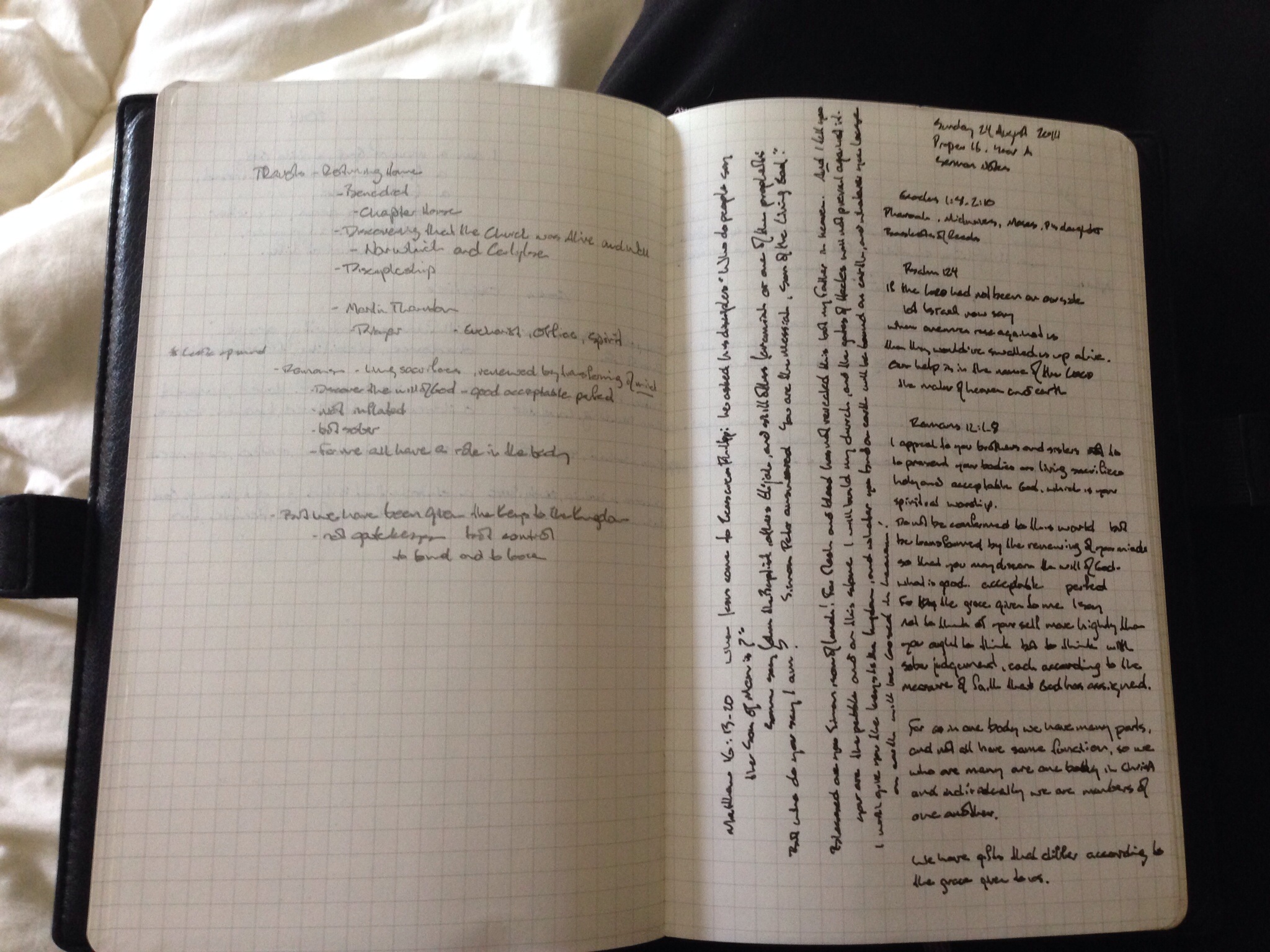
The prep included several pages of notes.  Here are two examples.

imageimage

The central conundrum as I understood it was that we are not called to this work and life for ourselves.  We are called to move outward, to grow up past the law into the ethics of ownership which includes some real responsibility.  In the previous weeks I had used the Keys to the Kingdom as a central image and wanted to talk about the bishop giving you those keys at your confirmation.  But after the first run through, I realized it was too small an image, and the sermon was too heady without a stronger image for Sunday morning.

Now my Saturday night congregation is primarily the long-time faithful who include about 25% retired clergy every week.  There are Jungian Christian explorers and older women who have carried the church for decades.  Collectively there is like a millennium of experience of faith there, so I don’t do a whole lot of drawing conclusions, almost always leave in the notes and obscuranta, and can leave a heady sermon knowing they will take it into their hearts.  I do have to be directive about encouragement, hope, and the need the church has for them to give back their wisdom and learning and faith.

Sundays is more mixed.  The eight o’clock service is quiet and is between Saturday night and Sunday at 10 am in terms of maturity.  I bring in more imagery and explanation, filter out most obscure note things, and start to draw more clear and concise conclusions.  I don’t have to push as hard emotionally with this group.  They are focused, and the service is quiet and easy to keep focussed without much rhetorical work.  I don’t have to repeat much and circle back as intentionally as the later service with music and kids.

Sunday at eight is a solid group though, and quick to laugh.

So you can see the development in the sermon, imagery, and delivery.  If you look back on the sermon blog, you can find Sundays where two versions are included and can compare.  Finally, I always circle back to the sermon in the welcome and announcements.  It is the place where I am reminding people of how to make this concrete and what they are bringing into the Eucharistic prayer and communion.

I hope this is fun for you.

Why the Rule becomes Rules – or should

. . . the Lord waits for us daily to translate into action, as we should, his holy teachings.

The Rule. Prologue vs 35

The Rule needs rules.  This is true of the Rule of Benedict and the Rule of God.  In the Rule, Benedict is translating the Gospel as he understands it into a set of rules for a monastic community.  Our work is to do a similar translation of the Gospel and the Rule of God into rules for our daily, weekly, and yearly life.  This work is deeply personal and not easily undertaken.  It calls us to examine our most deeply cherished values and beliefs because we need to articulate what we want to translate.

Articulating the Gospel and the Rule of God is the first part of our undertaking.  Benedict does this succinctly in the Prologue and throughout the chapters.  This led to the Rule being considered a sort of short version of the Gospel.  Our intent must be grounded in the same place, a clear articulation of what we understand the Gospel and the Rule of God to be.

We then must take that articulation and make it as simple as possible, not to be trite but rather to make it possible to consider translating that into the rules that we can live into.  This work is considerably easier when sitting before a good statement of faith.

Homework: write a clear articulation of your understanding of the Gospel and the Rule of God.  Not less than 50 words or more than 200 when finished.

Lifting their Hands – On not leaving pastoral ministry

Being a pastor sucks.  It is also wonderful in ways no other job is.  But there are days even years when the consolations of ministry are few and far between, and the critiques and mistakes form a flood that overwhelms the best of intentions.

IMG_4329

The Very Rev. Rebecca McClain asked me early on in mentoring me into the priesthood of the Episcopal Church what I thought it meant to be a priest.  My answer then is still one I am working out.  I said, “Being a priest means promising to be fully human, bearer of the  image of God and flesh and blood, broken and healed, in front of a group of people, no matter what.”  The vows of ordination are about the roles we play in the church.  But before all of the roles is this simple understanding that I hold about being a human being, a child of God in Christ, a Spirit-led person in front of a congregation.  To be honest about our humanity in its glories and failures sounds nice, but it is hard.  Rebecca and others have helped me to put flesh and blood to it, but it is often not supported and loved by the very people among whom we struggle to live it out.

To lead others toward their full humanity in God in Christ just makes it worse.  People don’t want to change, don’t want to take ownership of their life with God or others, much less practice self-sacrificial love.  People don’t want you to change them or their church, no matter what reasons you offer for doing so.  I know; I work in the church.

I was realizing all of this in the middle of seminary.  I was in my seventh year of ministry by then, having worked in churches and a diocese prior to seminary.  By the seventh year most people leave ministry, and I was ready to join them.  My life was ugly at the time, mostly due to my own shortcomings and sins, and plenty of both.  I was an exile from every community that I could turn to.  I was out of touch with my family, my home community, my various churches.

I was sitting in the dark.  I was actually sitting in the dark of a small chapel at a youth retreat preparing a Youth Encounter team that would be welcoming and leading other youth through a weekend experience of Christ a month leader.  I was a spiritual director for the youth and young adult commission of the diocese, and I was there at the request of the director,  whom we will call Julie.  But I was struggling with leaving ministry altogether.

I was sitting on the side with another spiritual director watching Julie lead the eucharist for the youth.  I don’t remember the sermon.  I was in the tunnel vision of struggle and doubt wondering why I would stay.  I was asking God, What is there in ministry that I would die for? What could I possibly do as a priest that would matter enough for me to give my life to it? Suffering and self-centeredness are natural allies.

As the service turned toward the eucharist, the most intimate and holy space for us as followers of Christ, Julie called two teens up to be the table.  One was this boy with significant developmental issues that made him socially awkward and sometimes very difficult, he was lovable and frustrating at the same time.  The youth had earlier in the day reached the point of excommunicating him and even cruelly pushing him away when one senior girl, a gorgeous popular teen, reached out to him and used her popularity to pull him back into the group and build him up.

Julie had these two come forward and be the table by holding the elements of communion, the bread and the wine.  And Julie, with her wild red hair and her effusive enthusiasm, began to pray the eucharistic prayer from the prayer book from memory.  I was engaged and leaned forward beginning to feel like here in this moment God was answering my questions.

When she reached the place in the prayer where the priest would normally take up the elements and elevate them, she instead bent down on her knees and lifted their hands.  In the moment when the profane becomes holy, she knelt and lifted their hands.

She lifted their hands!  They became more than sacred furniture.  She made them priests, the hands of Christ, bringing their full and broken humanity into the divine act of God in Christ.  It was holy.  It was priesthood.

Now I don’t know if one person there saw what I saw.  But I just began to sob there in the darkness.  I might have said, “Amen.”  But I know I said, “I will die for that.”

So I stayed, and I stay to lift up other people’s hands.  I am still pretty broken as a human being.  Mississippi pastors say we are all dirt and divinity.  I can’t say that I have Julie’s flair and instincts or Rebecca’s maturity, but I know why I am here, why I am still trying to do more than just preach and preside as a holy person doing holy things on holy furniture.

I am heir to that moment when Christ chose to call his disciples brothers and sisters, to take up the cross and set us free, to redeem human beings to be what God made us to be: a royal priesthood of sons and daughters, heirs, and stewards of the creation and each other.  I am heir to the God who comes and lifts us up, who loves us and commands us to love others, who kneels when we expect him to stand.

You are more than sacred furniture to God.  You are his daughter, his son, his beloved heir to the rule of love and grace.  Despite myself, I am still a pastor, and I will lift your hands until you hold them up yourself and make the world holy.


“The creation waits in eager longing for the revealing of the children of God.”  from Paul’s letter to the Romans

Giving Authority Away – Technique

Too little leadership material actually gives important tips for actually doing subtle things.  So here are a few vital tips:

Leaders are not on their phones.  We all know it happens.  But stop it.  Bad human.  Pay attention.  I am guilty and so are you if you have a smartphone.  None of the subtle work of leadership is ever going to get done inside you when you are on the phone.  Grow up.  The lack of discipline in public and private settings around computers and phones and tablets is horrendous.  People who would never pull out a novel in a meeting are playing games, checking social media, and emailing in the middle of meetings.   I have heard stories of pastors posting to Facebook while with dying parishioners and have watched people play games during a family member’s funeral.

Now that you are not on your phone, pay attention to who is watching whom in a meeting.  One of the biggest techniques to using (and building) credibility, trust, and authority in your work place or home is presence.  Mental and emotional presence is shown in the eyes.  Are you watching the person talking? Are you watching the person in power to see how they react when others are talking?  We give authority with our eyes.

Attention and presence are active.  They are done things.  We say you “are present” or “not present,” but what we really mean is you are “actively present” or not.  Actively indicates that we are talking about the expenditure of energy or being, one of the most precious things on earth.  To actually be present to a meeting is work that requires discipline, focus, and defense against distractions inside and out.

Everyone knows this at a gut level, so when we see someone that we give authority by placing their attention on someone else and being attentive to them, we move up the ladder with them, giving authority to the person they are attentive too.  But the sum authority is not additive, it multiplies.  Attention ups the amount of authority in the room.  Capable leaders know that and work to raise, maintain, and give attention to others carefully.

The eyes give authority or take it away.  Yes, people are watching.  I lecture my teenage daughters that everyone is not looking at them.  They can relax.  The lecture for adults is the opposite.  People are watching, but they don’t care about your jeggings as much as your eyes.  Set aside enough self-care and down time to not need to take it when you are with people who matter.  And if they don’t matter, don’t show up and pretend.  You have only added offense to offense.

Public statements of support are a vital technique to loan someone authority, but they have to be followed up on.  Otherwise they become destructive.  Go to meetings, grant permissions, find the money, follow through.  Everyone in a hierarchy has had a boss who would verbally support in the office and then kill projects in practice, all while smiling.  The euphoria of the smile passes, and what is left is poisonous.

Finally giving authority to someone else sometimes demands and almost always needs closure.  In a meeting it may be looking around after an important statement you agree with and nodding to show support or acknowledge a valid point.  In a larger communal setting it may demand that you stand up in front of the community and recount the deeds done and celebrate the person who actually did them.  Do NOT point out your support.  You are doing that by giving them the credit.  Pointing it out should only be done when public acknowledgement of failure is necessary.  This is almost never the case, but it does come up.  In that case, take the blame, take the authority back, and take responsibility for doing whatever is necessary to correct and move forward.  You are the leader.

In yesterday’s post we placed these considerations of authority under the considerations of values that lead us to use our authority for goals and objectives.  We return here to say that our values are what actually give us meaning and purpose.  For Christians understanding our values is one of the primary steps in translating love of God and others into goals and objectives that actually change things and give flesh (incarnate) to our theology.  Love is meaningless until the hungry person is fed.

So look up, speak up, and give away freely.

Giving Authority Away

IMG_4259

In this series of reflections, which are far from complete, we turn next to giving authority away.  To underscore two important points to be held in mind: every member of a healthy community has authority, and every member who has authority is responsible to God for how that authority is used.

Considering authority we have assumed some measure of self-reflection, honest self-assessment, and humility.  This next topic requires an even greater measure of all three.  In order to give our authority away, we must be honest about having it and consider our responsibility, but we must also be submitted to a higher authority than our own self-interest and beyond our self-interests, even altruistic self interests.  This is when Jesus’ teaching about hating family for the sake of his kingdom begins to make a whole lot more sense.

What do you value more than your own self?  What do you value more than your family, your nation, your tribe, your sports team?  This is a vital question for many Christians that goes unasked and unanswered in many churches because we, your pastors, already know the answers, and they are not godly.  We know your answer because we know our own.  Or at least we think we do.

It is the answer we see lived out in our choices about faithfulness to attendance, to charities, to causes.  It is the answer we hear behind the complaint about sermon or service length, behind the excuses, prejudices, and functional atheism of our talk, and its what we hear in our own self talk about why we feel burnt out and run over in doing things for “them.”  When we can honestly say that God’s Rule in our lives is our first priority and our first value, then our children can have a parent rather than a worshiper, our time is held in wholeness as well as holiness, and we aren’t wasting time in worship, or living lives that are overwhelmed with the secular world and its values.

I am writing all of this and honestly trying to live it out with this one stark memory from almost ten years ago when our girls were little.  My wife and I were in the front seats of the car, and our girls were in the back.  We were driving past Bell Road and  32nd Street when we drove by a homeless woman holding a sign asking for help.  The girls, both under seven, wanted to help, but I was in a hurry.  I don’t even remember why I was in a hurry.  They begged me to help her with money, food, water, anything.  But I argued back that I was too busy, that I had to get back to wherever it was that I was going.  I am still haunted by that sin.  I had an answer to whose rule was important just then, and it was not God’s.

The value set and getting that right is vital in a community before crisis or even just conversation.  We set values and priorities and reinforce them all the time.

There are times when we want to accomplish something that is bigger than ourselves and the authority we hold in a community.  We have to pool our authority with others in order to have enough to call others to the work at hand.  We have to give away our authority intentionally.

We often give away authority unintentionally.  This is often done in the silence when someone has called the community to do something that is not in keeping with our values or when they have asked us to do nothing in the face of our communal values.  In that silence, when we do or say nothing, we give them our authority as we seem to consent.  In the silence often people have consented to terrible things because they were unintentional about their authority.  They may think that saying nothing is objecting or just could not muster the courage.  They have just waited for someone else to say something, until nothing was said.

There are all sorts of little post-it note philosophical whimsies about the evil of unintentional silences after the Holocaust of World War II.  But there are millions more examples of smaller injustices or inactions that have gone unphilosophized but don’t go unnoticed.  We are accountable for our words, but I think we may be accountable for what our silences say too one day.

So, we hold a value that is bigger than ourselves.  We don’t have enough authority in the setting to accomplish a goal in keeping with the values we have, but someone else in our sphere of influence does.  This is when we practice giving authority away.

It may be upward.  If a boss or superior in the hierarchy can accomplish things we value, then it is fairly easy, respectable, and rarely controversial to simply “throw our weight” to them.  My bishop has a very similar vision for the diocese to my hopes for our church.  He can accomplish things that I cannot because he sits in a different chair with different influence and relationships.  So I give him my authority.  He has it naturally enough formally, but most people today do not assume that authority is given, so we must be intentional about giving those in higher authority the support we can intentionally by verbalizing those formal and giving witness to our shared values and goals.  It helps that we are simpatico, but it is important to have honest and transparent relationships with those in formal relationships with us so that shared authority is not just implied, but used in ways for which we are willing to stand accountable.

We may give authority away to those below us in the systems in which we work.  I have employees under me that are doing things that I value.  I loan them my authority by hiring them, but I also verbalize my support publicly and am willing to be there when called upon to stand with them and give them my authority to do what they need to do, without taking over their work.  This is more tricky than the vertical move upward.  Giving authority to our superiors is fairly easy, but when giving our authority to those under us, we have to be very self-aware of motivations and very clear about what our values are in stepping in.

If I value what an employee is doing, I express it by calling to the shared value their project and giving voice to their work and accomplishments, or at least their hopes and goals.  This allows them to borrow my authority while keeping their own and staying in command of their own goals, hopes, work, and accomplishments.  They are still the ones accountable for their own success or failure.  This is giving authority as opposed to taking authority, which is only to be done when someone is in desperate need to be saved or has completely failed.  Taking authority is devastating to the person who has it removed, even when they are grateful, and it should be avoided at almost all costs.  One of our primary values is the dignity of every human being from our baptismal covenant.  We preserve their dignity when we give them our authority without taking theirs away.

Have you seen a boss take authority that did not belong to them? How is that different from taking credit for others work?  They often overlap in unscrupulous cases, but let’s assume good intent.  Have you ever taken authority unintentionally or given it away?

We often pass authority to others without thinking horizontally.  We loan our word, our voice, our credit to others in subtle and overt ways.  It is important to be careful when we do this because we are the ones responsible for that authority given to us by God and our fellow brothers and sisters.