Holding Authority in Community

So the secret is that you have authority and that you give authority to others.  This true whether you think it should be or not.  It is true whether you like it or not.  It is a social principle that is reliable.

The moral principle that is corollary to the secret is that you are responsible for that authority.  We are made, in our Christian understanding, to be stewards for God on earth, caretakers of creation and one another.  This is central to what it is to be a God worshipping, Bible believing, human being.  We are made for this task.  No other creature of God is given our role, calling, vocation, or gifts.  The dolphins are smart, but they cannot manage ecosystems.

Human beings are made to be God’s stewards.  A steward is a house manager who manages the affairs of the master of the house.  They are to act in the master’s stead.  They are expected to act as the master would act if the master was present.  They are to care for the people and things of the master’s household and property and to be ready to serve the master by overseeing all that belongs to the master.  This is stewardship.

Human beings are gifted to do this work.  We can understand, study, imagine, create, and manipulate whole systems and subsystems within the world.  This is both wonderful and  terrible as we see almost every time we turn on the news.  We use our gifts in amazing and terrifying ways.  We are blessed to be a blessing, and we are fallen from grace, going on our own way, serving ourselves alone, which is one definition of evil.

Okay, so what does all that have to do with holding authority?  If we don’t know who we are and what we have, how can we be responsible stewards?  We have been given tremendous authority by those around us.  When we ignore this and act powerless, we betray them, our vocation as human beings, and God.  When we manipulate that authority to our own gain above others, we betray them, our createdness, and God.

We hold authority humbly when we are honest that we have it, when we tend to it, and when we use our authority to further the work of God to create, redeem (set free), and make new.  If you are sitting in a meeting as a Christian, whether anyone else knows you are or not, you have a duty to be honest about the authority and trust that others have placed in you, to speak honestly and call the gathered community toward that which is good and creative, redemptive, and that gives life to others.

There are those who deny that they have any authority.  This is either cowardice or avoidance or the truth in an unhealthy system of relationships.  I have rarely found it to be true.  What I have found in systems is that when I have no authority at all, I have either given it away and sometimes rightfully so or it has been taken.  The other reality is that we may face and often face times when our own authority is not enough to accomplish the creative or redemptive work.  We must then either make allies and pool authority or we must persuade others through appealing to higher authority within group norms.

I may not have the personal authority in my parish to make deep changes to our common life even after five years of pastoral work.  This may be due to squandering my pool of authority and trust on other projects or goals.  I have lost authority due to poor planning or results, poor communication, or past infidelities to our common master.  In that case  I must appeal to the higher authority of either God, in the case of the church, or to the Bible or our commonly held values and goals.  This must be done carefully, and I would add prior to the need being desperate.

Authority is really a form of trust. Thought of this way, it is easy to see how it relies on integrity, honesty, and honor.  We have to prove trustworthy.  The past matters.  It is not all that matters.  Honesty and integrity are always present tense, but built on the past.  On the other hand, a vision of where you are leading the group is vital.  The future needs to be as clear as possible, at least in the form of intentions and plans.  This is part of what makes authority.

Appealing to other people’s shared authority requires really clear communication about what is presented and how far the commonality of the common purpose really goes.  My associate pastor and I are lock step on certain communal values.  Either of us can state with integrity and honesty that we agree and support certain positions, and everyone can see the truth of that in our history and current practice.  They know our vision and plans and can judge how far to trust us.  And if we are talking about the areas we hold commonly, that trust and authority can be given freely and held honestly and used to further our community values.

But there are areas where we don’t see eye-to-eye.  We are different people after all.  For the most part, these things are not central to our common mission and vision.  They do not deeply affect our community.  If we were to pretend to hold a common set of values there, we would have to either agree to support one another despite differences and work out whose values were to be presented, or we would have to be honest about a disagreement on values and work out what values would serve as the communal norm.  These negotiations are vital and vitally done privately and hopefully before a breech in the image portrayed to the community.  It can be handled well and honestly, and relationships can be saved with integrity and communication, but it must be honest.

To appeal to higher authority seems tricky and can easily slip into manipulation.  We are made to manage systems after all, and it is all too easy to manage the system to get what we want in the short term rather than attending to the health and vocation of the whole system.  This quickly leads to institutional sickness and even death.

We have to return to our original vision.  We are stewards of God’s house, and God’s hope as I understand it is that his children would all be in direct relationship with God, not dependent on other “fathers.”  So we have to use our authority in such a way that assumes other’s direct access to God, provides avenues for access, encourages use of those avenues, and then doesn’t short all of that out in order to get what we want in the short term that is of lesser value.

So, in the Benedictine model we assume everyone has access to God’s Spirit, so we call the whole community together.  We provide avenues for accessing both the situation and its reality and God’s Spirit.  We may do that by clearly explaining the relevant parts of the situation and giving people time to understand and to pray.  We then encourage prayer and give time for people to pray.  In our parish that has meant months before some major decisions, but sometimes it may mean a few minutes right then.  It depends on a number of factors, but I would advise going long rather than short, but short enough that you can be accountable to actually making a decision.  Time is a vital component in any significant time of discernment.  It should not be too little, but then it rarely is these days.

Practically the appeal to higher authority should be a part of every meeting and it should be democratic in that the appeal is to an authority to which everyone is obedient equally, including the leader, and it should be normalized so that everyone remembers what the overseeing authority is.  That is why it is vital to have a mission, a vision, a purpose to exist that is short, memorable, and should be direct enough to make you grow up to hold on to it.

If you are going to appeal to a higher authority, everyone should have access to it and be held accountable to it.  That means that the priest is not the only one who can read Scripture, and the priest may be called up short to by Scripture.  It is important then that people be hold what higher authorities hold sway in a meeting and that these higher authorities be agreed upon in order to belong to the group.  Every cop and congressperson has to swear allegiance to the Constitution.  If they did not there would be no check on power.

If you want to grow your own sense of responsibly holding authority, acknowledge your given authority, explore your vocation as a human being, tell the truth with love, be honest about what your vision and mission of the group and yourself is and communicate that to the group, and use your authority to do creative and redeeming work.

We all hold authority.  Hopefully these reflections will help you hold it with a little more self-reflection, honesty, integrity, and responsibility.

Who Has Authority in Community

In my last post I questioned the profiteer from the past who attempts to hold authority by claiming it from some external place.  So who do we give authentic authority to in community?  This may be one of the  make-or-break questions of church leadership.

IMG_1560

Some people take the room the moment they enter it.  This couple in my first solo parish had that power, or rather the wife did.  She was a presence in every room she entered, and everyone responded to it.  She could build up and destroy.  And usually she destroyed.

My parishioner was a natural born leader with charisma.  She drew attention and people to herself.  She was truly magnetic.  But she used it constantly to complain and control through negative talk.  Every story was negative unless was about her.  Every opinion was negative unless it was about her.  It was real power, and it was totally unconscious.  She destroyed community, and it was only through the balancing presence of other more positive leaders in the church community that her effects were not more devastating to the long term health of the church.

She had power, but she was given authority by those who responded to her.  In the past, I and other leaders had given her additional authority by putting her into responsible positions, thinking that this would somehow cause her to be more self-reflective and responsible.  But her power was unconscious and her ability to therefore wield it responsibly was simply missing.  I loved her, but I began to cut her off intentionally and to build insulating walls around her with people who did not give her authority until over time sickness took her out of the community.  It was passive aggressive to be sure, but I followed up with direct confrontation one on one of specific behaviors when they arose.

One person with a great deal of power can truly stop a community’s development and growth in the Spirit cold, at least for a time.  She was powerful, and we made it worse by giving her authority.

In communities, it becomes important to think seriously about authority, especially as leaders.  A natural leader has real power whether acknowledged or not.  Everyone has the potential to be a leader, but some people are just born magnets.  It is important to be self-reflective and humble enough to be honest about your gifts.  If you are born magnetic, you then have a real responsibility to be careful in community in regards to the influence you have.

Authority though is something no one is born with.  Authority is given.  It is part of the social realm that is negotiated consciously or unconsciously.  We give authority either formally with titles or roles or informally by habits and deferences.

Formally authority is given by title or role.  Because I am a priest, I have certain authority within my church community.  It is given.  I also have some remnant of authority within my larger social community, though it is not as certain as it was in the rumors of the past.  I also have some powers because of my position within the hierarchy and institutional structures, but our focus today is authority.

It is my thesis that in healthy communities we give authority to each members as they take on responsibilities.  This begins from the time a member begins to take responsibility for regular attendance and participation in the story-making of the community.  Once you begin to ask questions and show up weekly, you have begun to accrue a certain store of authority among the members.

We are in an awkward place in the institutional church today because we have regular attenders who are helping to write our communal story but are not members.  This is dangerous because without the responsibility of formal recognition we are allowing people to determine our future with us.  Dangerous does not always mean wrong or even bad, but we have to be self-reflective and intentional about how much we allow those without a stake to play key roles in our communities.

In the Episcopal church, we have traditions that are supposed to mediate this danger by insisting that people be members, baptized and confirmed and in good standing, in order to hold key offices and even perform key tasks.  In these later days, many of our churches though, hurting for active members, have allowed active non-members to step in without asking for the formal declarations and rituals of belonging.  This is understandable, but in my recent work around the church and Benedictine ethos, I have begun to question the risks of these dangers.

First off, we are not talking about hospitality.  Everyone is welcome.  The doors are open.  Come on in.  We love you.  We have to love you if we are to be Christian, much more so if we are to be Benedictine.

Secondly, we are not talking about rights.  Certain things should be true about how we treat everyone without regard to their behavior or gender or class or other distinctions.  The church has fallen down on this to be sure, but let me give a couple of simple examples so we can move on.  Anyone who comes into church should be able to expect to be welcomed, loved, and given a seat.  They should be safe and free from ridicule much less violence or mockery or hate.  This is not based on them, but rather on the ethical code of followers of Jesus.

These things are true and should be reliable in church because of what Jesus told his disciples to do and be.  It is shameful that some populations of people feel hated by the church because of our words and actions of hate or ridicule.  It is natural that some people will disagree with us and even hate us for what we say and teach, that is not the same things as actively singling out people because of who they are or what they have done.

What we are talking about is authority.  As we begin to participate actively in a community we begin to accrue authority given by the members because we are taking an active role in writing the story of the group.  This is natural and reliable in healthy communities.  That deposit of authority grows when we add formal participation and belonging.  It grows as we develop and deepen relationships and responsibilities.

In the Rule, Benedict recognizes that God may speak and often does through the youngest members or in our vocabulary the newest members.  We should be listening for God’s voice then and setting up systems and habits as formal leaders to communicate with and listen to those voices.

The question that has haunted me on my travels and reflections on the architecture of Benedictine communities is, Are there people who should not be in our chapter rooms?  I believe there are.

I have never been into the chapter room at Saint Gregory’s in Three Rivers, Michigan, though I have been on retreat there.  I am a priest in good standing in the church they belong to.  I am love them.  They love me.  I think they do anyway.  I have eaten with the brothers.   I have prayed with them.  I have sat in long silences and read their books.  But I have not been in their chapter room.

The chapter room is interior space.  It isn’t for everyone.  It is not exclusive.  It is intimate.  It is a place for the community to do its business.  In the current state of the church, we have let people who don’t have formal belonging act and live as though they do because we have no boundaries.  And so we have mistaken access and authority for love.

I am loved by the brothers of Saint Gregory’s, but they don’t give me authority.  They don’t cut me off, they just don’t let me in.  It would be a mistake for them to do so.  It would be a violation of their community norms and would bring in dangers that are too great over time to excuse.

This all seems pedantic, I guess, except that it is very relevant to our situation in the Episcopal church today.  We have left the doors open to our chapter rooms, and we have let in those who though we may love them, may agree with them, we should not be letting them write our future.

That statement seems at odds with a Western world that demands openness to all comers, and at a time when government and institutions are taking active steps to force open all doors even in church groups.  Recently colleges have begun to deny access to campus to groups that insist on a dogmatic statement to lead.  The spirit of the age is inclusivity, but when have we gone too far?

It is vital to think and act carefully as stewards of God’s world and Christ’s community.  Here we must carefully discern whom we allow to hold authority.  Can we draw lines carefully? Or must all lines be erased?  More and more who the church is and what our future will be is being written by those who have not committed to Christ or the local community.  I am the first to say that as a pastor I have members who are central to our community who are not members.  But I am more and more deeply troubled, not because I need to control who becomes members, but rather that those who have not committed to the future are helping determine it.

In the larger Episcopal church we have let advocates and supporters write legislation and underwrite controversies with little reflection as to where the money comes from or who is holding the pen for our tomorrows.

If we are to live into a Benedictine vision of leadership we must lead by being willing to commit to people, to loving wildly, and to creating places to hear the voices of our communities, and communicating how to become members, giving authority liberally to those who commit, and to closing the doors that need to shelter those who are trying to hear the voice of God.


Walking around Whitby Abbey with Hilda and a Camera

IMG_2311

It was a perfect photo day in Whitby.  We drove over to see the monastery that held both Hilda and Bede, not to mention the great poet Caedmon.  It was founded originally in 657 by the Northumbrian king who appointed Hilda as abbess of the dual monastery, serving both men and women.  This was not uncommon in Celtic monasteries.

IMG_2243The monasteries founded in Scotland and Ireland between the late fifth and seventh centuries primarily came from Ireland, most by way of Columba’s monastery in Iona.  Aiden had already founded the community on Lindisfarne, which produced holy Cuthbert.  These holy islands belong to a massive missionary movement from Ireland.  From the islands the monks converted the locals to Christianity in a wave that would startle and possibly scandalize the church today.


By the time Hilda became abbess of the dual monastery at Whitby, she was expected to serve as more than a small religious community leader, she was expected and did become a force for local governance.  This expectation was surely helped by her heritage as grandniece of Edwin, king of Northumbria.  Her family certainly showed her noble heritage, but she was more than an heir of good breeding.  Bede describes her as an able administrator and teacher who seldom rested.  Her administrative skill was matched by an ability to spot and encourage others gifts, notably the aforementioned shepherd poet Caedmon.

Her baptism though in 627 had been by a Roman bishop-monk Paulinus who had come to England with Augustine and had baptized Edwin and the rest of his household.  Did that connection then effect the outcome of the Council of Whitby where the Roman system of calculating Easter and establishing Roman norms in Northumbria and later England?  There was already a strong influence through earlier Christian influences going back to Roman occupation, from which Patrick was converted and returned to Ireland two centuries before.


IMG_2255

The ruins around us on Whitby’s hill are not from Hilda’s time.  There are very few artifacts from the later monastery, easy to understand when one considers the nature of early monastic settlements, more like rustic wooden towns than the later massive stone structures of later building periods that we more often associate with monasticism.  The Benedictine monastery of the eleventh and twelfth centuries that left the beautiful ruins was not of the same character as Hilda’s abbey.

IMG_2284The later settlement by Reinfried was Benedictine and based on the gift of the site by William de Percy and included the town and port.  The port and town remained small though the influence of the newly re-founded monastery reached across Christendom because of its relics.  In the eleventh century as the church began to rely on pilgrimage and the power and pull of relics to improve both religious and economic life, the abbey was susceptible to the same temptations as the church at large.  They charged heavy fees and build magnificent buildings, driving the monastic community into debt to feed the ego of a couple of more greedy abbots, according to the English Heritage headphones we were wearing.


We come then to the growing lesson of my first few weeks in England.  The holy sites of English tradition often show this double-founding, the first founding being based on a legitimate desire to create a holy community based in a life of discipline and right-living often based in a monastic ideal, but not always strictly based on Benedict’s Rule.  St. David’s, Caldey, Lindisfarne, Iona all began in slightly different ways, but with the same marks of discipline and holiness, based in character of life.  The examples extend outward through countless other communities, early Roman, Norman, Benedictine, Augustinian, Cistercian.  They are born out of mother communities in Rome, Ireland, Scandinavia, France.  The initial foundlings are based in a genuine motivation for evangelism, holiness, and missionary motivation.

IMG_2176The success of these communities varies widely in terms of influence, wealth, and even survivability.  The rule or character varied quite a bit as well depending on who founded them and what tradition they inherited.  But they did have incredible reach in terms of the Gospel.  It is an amazing time, especially when you look back through history.


On the other hand the eleventh and twelfth centuries are marked by new monastic settlements, too.  It is remarkable the reach that those monasteries and priories had.   But what becomes clear in a few places is the greed and power-lust that accompanied certain sites, especially those re-founded on sites previously considered holy.


IMG_2243

The Western world could be said to relate to either time.  That is one of the tricks of writing about history.  Christianity is in decline, according to some numbers.  The world created by Christianity in the west is rapidly changing, either becoming decentralized away from its Christian center or decentralized globally becoming less central to how we view the world.  In both of those scenarios Christianity is diminished in terms of the West, either because it moving away from being a Western religion or because the West is just less religious.  In global terms, it is also true to say that just as Christendom moved from a Mediterranean center to a more northern one, so we could say that Christianity is moving east and south again and not diminishing much at all.  In that case, it just seems like it because we are no longer in the center where our faith is located.

Christianity was moving in both the fourth to sixth centuries and in the tenth to twelfth.  The question that ruins of Whitby asks of us is “What will we do here and now?”  We can claim this time as a time for holiness and evangelism to our own people and culture, or we can look back at the past and mine it for current profits.  It is remarkable to see how England and Wales have preserved the past and make a decent profit off our secular pilgrimage.

The ruins of Whitby mark a thousand years of profiting from pilgrimage.  There was a time when the monastic community could rely on the faith of the people to impel them to give almost any amount to be close to holy things.  That holy past also guaranteed a certain amount of political power that was drawn on for profit as well as to do good.  We certainly see both in our day.  In the United States we tend not to charge admission to our churches, but then we don’t have the relics to draw in the faithful.

IMG_2177But it isn’t that simple either.  We have movements within Christianity that look to the past for current holiness.  That is a similar impulse I think to the pilgrimage impulse.  Only it may be a three hundred dollar leather Bible that relies on its stilted language to convey a sense of holiness. (I am susceptible, though I can’t afford the best that Allan Bibles has to offer!)  It may be a claim back to the Westminster Covenant or the XXXIX Articles that gives us our authority, or it may be the bones of Hilda.  The pilgrimage impulse is the impulse to look to a holy past for current hope.

I am not opposed to the pilgrim, but rather to the profiteer of religion.  He uses God’s name in vain, and sublimating blasphemy through the saints is no better.  The religious profiteer turns God’s house into a den of thieves and needs exorcism in our day as well.  That is what Jesus was doing in the temple, a good old fashioned Galileean exorcism.

As a pastor I am leery of the lurking tendency to claim authority based in the past.  I have been told dozens of times in the last decade that we had to preserve history.  Now clearly, I love history.  But preserving history it not my job.  Neither is it my church musicians’ or my worship team’s or the Episcopal church’s.  It is tempting to preserve the past and sell it in decorative heritage jars.

But that temptation is satanic.  It takes us away from the true call of our day.  We are called to serve God in our day.  To be holy in our times of unholiness and rot.  To evangelize our culture.  To heal our sick.  To welcome our stranger.  And all for free.

IMG_2220Jesus was asked by the woman at the well whether it was right to worship God on this mountain (the holy site of her ancestors) or in Jerusalem (the holy site of Jesus’ ancestors).  Jesus replied, But the hour is coming, and is now here, when the true worshippers will worship the Father in spirit and truth, for the Father seeks such as these to worship him. (John 4, NRSV)

How do we worship God in spirit and truth?  The hour is coming and now is.  It is present time, our worship, and always must be.  We have to be really careful to tend to the holiness and love of neighbor of our day.  There is a shepherd composing poems right now in your church yard, and probably in Spanish.  Attend to his gifts, encourage his success, and celebrate his use of God’s grace in this time.

IMG_2262

I don’t have Hilda’s heritage of nobility.  I don’t have the support of the Northumbrian king, but I have this day.  And my job is to lead my community to worship God in it, to be holy in this hour, to love and reach out to our neighbors, secular and heathen alike.

In Whitby I was struck that the church that sold its birthright to pilgrims, fleecing those who came rather than going out to those who were in need, was the one that left such beautiful ruins and so few saints.

IMG_2164


FranklinCovey and the Beginnings of a Rule of Life

IMG_4753

My introduction to the ideas behind forming a rule of life began during college when I discovered FranklinQuest planners and the book Ten Natural Laws of Time and Life Management by Hyrum Smith. The simple pyramid scheme of determining life values then translating those into goals and daily actions has been a part of their formula for success for years.

I think what is helpful for a follower of Christ is that our faith, like a value, needs to be translated into concrete daily steps. In Benedict’s Rule he lays out a daily schedule that forms a backbone of prayer. In our lives, we need something very similar if not exactly the same.

We need a schedule of prayer, and like the Rule it may change seasonally, and we need a set of guidelines for making our faith and community realities rather than concepts.

A lot of faith can feel like Jesus wall paper on the rooms of lives in which we live as functional atheists. If my faith is to be something that becomes a virtue, a lived value that becomes as natural as breathing, I need daily activities and a schedule that makes that happen.

I rise and pray. We pray before meals, every meal no matter how small. I don’t eat without thanking God, not because anyone else needs it, but because I do. I do evening prayer, usually long after the “vesper light” of the prayers. I stay really faithful to the Book of Common Prayer, but I almost always use apps on my phone.

I want to give a direct plug for http://www.missionstclare.com They have consistently provided a solid form of the daily office of the Episcopal church for as long as I have been crossing myself. I skip a lot of it, frankly, but never the opening, Psalms, Gospel, and Lord’s Prayer, daily collect, and blessing. That sounds like a lot, but it only takes as long as checking Facebook or reading the AP wire. And neither of them make me a better person.

A simple schedule and daily actions. My daily actions are not noble or great. I plan something everyday for my wife and I, some intentionally clear time with kids, and time to pray, study, and write. My life is overflowing with service for others and time with others as a pastor. I don’t have to work at those. What I have to plan in is marriage, family, and friends.

Becoming more Benedictine means living into stability and transformation. Taking these lifelong values that define who I am, or can, and making them into daily actions means that I have the chance to hear God say at the end, Well done, my good and faithful servant. Enter into my rest.”

And I know that is really simple, but it is my reason for having a planner.

There are No Inalienable Rights

We don’t have inalienable rights endowed by our birth.  We don’t.  I love Thomas Jefferson more than you do, and I think he was right about a lot of things, including this one.  We have rights “endowed by our Creator“.  They are not inalienable rights, either.  We make them alien when we fail to live as God’s people.

Jefferson was smart enough to see that we have rights because there is a social covenant*, a covenant that binds you and me in a common life.  Any rights we have are given by our living into our covenant.

Test it out: take a baby of any race out into the woods and let him (or her) vote.  They have no right to vote given by the Creator.  Instead they will die slowly and probably horribly unless us or one of God’s other creatures steps forward to care for them, love them, and raise them up.

I am not arguing for social Darwinism.  Too often Christians have completely given up moral philosophy to biological impulse, or as Paul called it “the flesh.”  We are endowed with Spirit, and the Spirit teaches us, and what it teaches is law and life.

We have rights because we have a covenant.  That covenant is spelled out in the Bible as the Torah and then the New Covenant “Law of Love,” that Jesus teaches.  Both of those laws are versions of covenant, and they command us not to hold on to our own “rights” but rather to a set of social responsibilities that teach us what the Creator made us to be.  Our “rights” derive from all of us living rightly, or in Biblical language “righteously” that is to God’s approval.

We have to work at knowing who God is in order to get our social responsibilities straightened out.  We don’t serve a god of violence and retribution that we often create in our own worst image.  We don’t serve the god of our tribe, though that god is still very popular even in our day, even in our churches.  We serve a God who made the world for pleasure and called it good, who set us to keep it as stewards with dominion.  We serve a God who is about our redemption when we fall, but who lets consequences pay out unless we repent, and sometimes by grace, even when we don’t.

As Christians, we serve God who is known as Father, who sets our boundaries and defines our relationships, rules and provides, and we serve God as Abba, who has given us new birth and holds us, calls us by name and sets us free, who loves us and forgives us.  And we are supposed to become God’s children who do those same things, as Jesus our Lord did.  And the Spirit teaches us how, moving and dancing, reminding and teaching and making us new.

When we live into our covenants and the laws of God our Creator, we create rights for everyone around us that extend beyond the abuse-boundaries of the laws of our land.  A lawyer friend always reminds me that “the law is not made for the righteous man.”  The thing is that the righteous human being lives the law into irrelevance.

As we grow up from people who need to learn the rules, to people who can keep the law, we become people who don’t have rights so much as give others rights by our righteousness.  We supersede law in love, moving from protecting rights to providing life, and from defending against injustice to defining what justice means, the human being in right relation to God, creation, and other human beings.

When we find a baby in the woods, the law tells us many things, but love tells us to take it up, love that baby, give her a name, feed her, care for her, teach her, raise her up, so that she can take her place in the stewardship of the world and live up to the covenants of the children of God.

And that is why the people of Ferguson or wherever else violence defined by race or gender or nation raise their heads feel more than grief.   Their anger is righteous due to the expectation at the very level of  being that the covenants that make us human are being violated by the ones who are supposed to protect them.

We understand that sometimes protecting the people who live according to the covenant means a violent justice, but it should not and only as the last of last resorts.  But if our understanding of our basic human responsibilities under the covenant are out of line with our cultural norms, we are in real trouble.  Our cultural norms collapse from a call to mutual covenant to self protection, Darwinism at its 18th century worst.

When we are just protecting our own “rights” we miss the point. We have to protect each other. There is no other way to have a covenant based life of togetherness.

The alternative is violent coercion.  The alternative is violent freedom that belies our best intentions, which are called “best” because we are usually at some lesser place.

I am not arguing for theism.  I am arguing from theism.  I am a Christian.  I follow Jesus and have promised to live by his teachings embodied in the New Covenant and based, rooted, and understood from the Original Covenant of the Hebrew Scriptures.  I cannot leave a baby in the woods, and I cannot watch idly by while my neighbor gets destroyed by those who are supposed to protect them.

We have police to keep us safe, to defend the version of the covenant that we have enshrined in our country’s Constitution.  We should be a people of law and law evenly and fairly applied.  We should support the police while living in a way that makes their job as unnecessary as possible.  We should grieve when their job demands violence, but we should also ask our selves how much violence they actually should expect, and not be prepared for more without reason.  We should fire and prosecute them when they violate their oaths, but they should be able to expect us to keep ours as well.

Christians, we must live as we were created to live.  We have stewardship of the creation and should protect it.  We are called to love each other and protect and help each other, and we should, we must.  My favorite verse in Leviticus is “If your neighbor’s ox falls down in the road, you should lift it up; you shall not refuse your help.”

The news, this month from Ferguson, reminds us that we have work in front of us if we are to steward the world with the compassion of God.  We cannot ignore the stranger in the marketplace because of his skin color, language, or clothes; nor can we ignore our responsibilities toward him.  Not if we claim to love God.


*Covenant is preferable to contract or construct or other similar words because a contract’s obligations are dependent on parties keeping the contract.  A covenant is a binding statement that changes the realities and identities of the parties involved.

The Chapter Room – Travel Notes

During our travels over the summer, I dragged my family through dozens of former monasteries, abbeys, and friaries.  I can recognize all the various types of stones from one end of the British isles to the other in the backgrounds of movies.  The features started to run together for my family, not being obsessive over the same issues.  There was one feature that stood out from place to place as they began to grow familiar.  It was the Chapter Room.

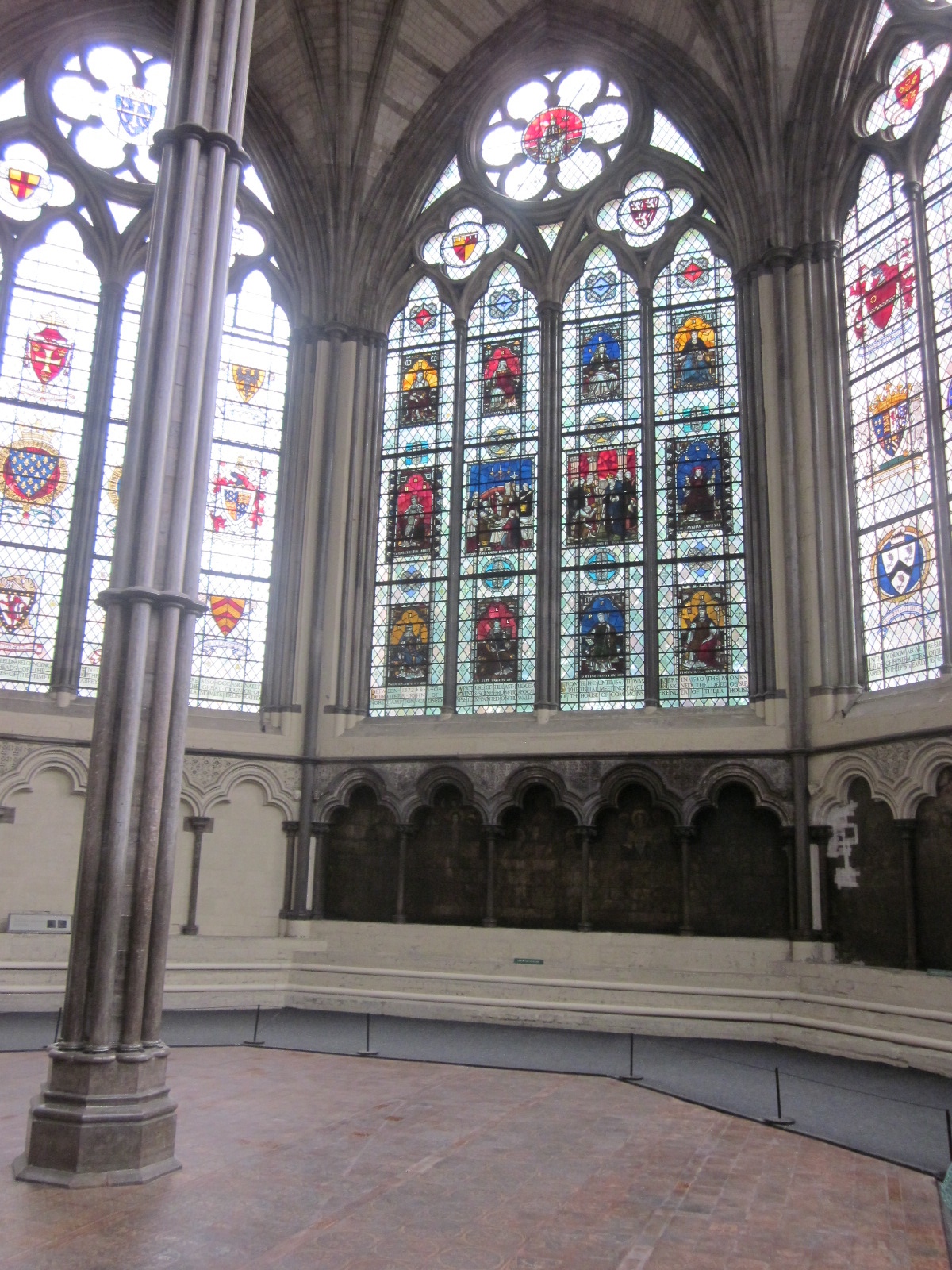
In Benedictine life, and other orders as well, the Rule requires that after mass or at another time of the day, the community gather to read and discuss a chapter from the Rule.  It is also the place where the abbot or prioress might call the community together for business that required everyone’s insight.  They were often round and quite beautiful.  There was usually a bench around the outside wall, though active communities also had chairs, they were quite rare when the communities were founded.

The Chapter Room was replaced in Anglican life by the Vestry.  This was a sad development in a way.  Not that I think Vestries are a bad innovation.  Business in a lay community requires a different ongoing oversight that would it would be superfluous to involve the whole community.  But we rarely see a place outside the sanctuary where the whole community is gathered.  Our fellowship hall at Grace is not even large enough for our whole congregation.

I am not advocate of multi-use facilities because I have come to see over time that our architecture expresses our anthropology of community in particular ways.  As Louis Weil used to say, “When it comes to liturgy, the building always wins.”

What if we saw our entire community as essential to the mission of our church?  What if we didn’t accept members unless they committed to the ministry of the congregation?  What if we built our community into our space?  Shared leadership or mutual ministry models often miss that there is a particular charism to leading that is necessary to healthy community.  As I have written elsewhere, leadership is service.  My towel work may be telling a group that it is time for them to stop meeting at our church.  I believe in leaders as necessary, as necessary as toilets.  But on the other hand, I also advocate for shared stewardship, the ownership of the mission by the whole community.

IMG_1220

The Chapter Room at Westminster Abbey

If we are to embody a whole community as part of the wisdom and necessary to the function of our congregations, do we need a Chapter Room?