Juggling Chainsaws on a Treadmill

SEARS Chainsaw

Craftsman 42cc

I hate treadmills.  I kicked the front off of the first one I ever tried in a box gym years ago, and I have since struggled to find my stride on them.  Give me the danger and the dance of the trail anytime over the mundane plodding of the endless rubber mat.

This week is a treadmill week.  The rubber mat of my week keeps coming like the tread on the mill continually renewed and refreshed, while I keep bouncing along trying not to kick anything over.

Acedia is one of those underused old words.  It means spiritual sloth or apathy.  The danger of treadmill weeks is that we keep putting in the work without the spiritual self investment that makes the work worthwhile.

Our work, even holy work, becomes toil, endlessly chasing that which will never satisfy. And the wiser my soul gets the faster she realizes that I won’t be satisfied, but neither can I get off the treadmill.  I cannot walk away from the work on weeks like this, because the work is both mine and meaningful to the people I serve.

Whether your work is church work or parenting, banking or grave digging, you have had weeks like this.  It is one of the afflictions of life.  I want to write “modern life,” but the truth is that acedia has been a popular affliction for a long time.  The spiritual masters write about it as often as sexual temptation.

Benedict’s prescription is two-fold: love and humility.  These two are embodied in our service of others and in our tears in prayer.  On weeks like this, I have to be diligent in my focus on serving others.  The moment my internal eye turns inward, I am caught in bitterness rooted in pride and self-pity.

But when I can keep my attention on my wife and children, on my parishioners, the poor and needful, even just on the waiter who brings my food, the more easily my perspective slips back to divine alignment. My motivation returns to love of others.

Humility is mid-wife to happiness.  This is not an idea I could have even articulated earlier in my life.  I often turn to God in tears over my shortcomings and sins.  I know my limits all to well and turn to God in prostration and tears.  Benedict has several references to tears that shocked me at first encounter with the Rule.

Really, how often do I cry in prayer?  But over the years as my realization of the reach of our lives and our potential as God’s children has become more real, so has the weight and pain of my failures.  And as counterintuitive as it may seem, nothing cures acedia as quickly as humility and tears of compunction.  I rise from the floor ready to go back to work, seeing others as holy and godly despite their faults and mine.

So what do I mean by chainsaws?  Beyond the danger of acedia, some weeks throw chainsaws at you.  This week it was a young woman’s death and another homeless person whom I simply can’t reach.  It is a budget shortfall and a visit with the bishop.  These moments require acute attention and focus that seem beyond my reach on a treadmill.

I want so badly to stop the flow of life and deal with each of these vital issues, but what I do instead is learn to focus on the run.  I catch and let the momentum throw the chainsaw back into the air, so I can let it go and catch the next one.  And let it go and catch the next one.

And learn that love sustains us for a while, a long while beyond the limits of what we think we can do.  Slowly these chainsaws will get set down one at a time, and there will be a time of rest.  Soon.  Soon.

Bless the runner, Lord, with an end to the trail in green pastures and beside still waters.

What we leave in our wake

The last six months have been filled with changes for my family and me.  In August we went from having a resume out but assuming we would be in Traverse City for another few years to getting one call back after another to return to the deserts of Arizona.

Those calls turned into visits, an offer, affirmation from the bishop, quick sell of one home and purchase of another, packing, discarding, and driving.  We celebrated Christmas in Phoenix for the first time in eight years with my family and began a new ministry at Christ Church of the Ascension.  I am writing from my office overlooking desert and our memorial garden and parish hall.  Surrounded again by books and icons, I am beginning to get enough traction to stop and process.

Leaving a parish is always hard.  I did it very poorly when I left Phoenix all those years ago, and I was determined to do it right when I left Traverse City.  Then the call came.  There was misbehavior at the parish before I arrived, and it had not been handled well, so we spent a year behind the scenes trying to see justice done and protect victims.  It was horrible.  But in the end, justice and mercy seemed to kiss, and we began to move forward. Between my announcing my leaving and actually being gone, the man involved was reinstated to ministry and moved to a nearby town.

Meanwhile a ministry bought our home that provides housing for those in recovery.  I had supported the ministry in its inception because it was so sorely needed in our area. And we have watched the absolute devastation that addiction leaves behind.

We drove away as we had planned for two months leaving in our wake two forest fires, one I had done everything I could to put out before and prevent from ever happening again and one we believed would be good for the place we loved but left.

Our lives leave wakes, and the deeper we run our boats the deeper and more lasting the effects.  My wife and I have lain awake at night praying for and hoping for good to come out of these events that we had important but only partial roles in.  We both worry about the legacy we left behind.

As a priest and pastor, my one calling is to build to Rule of God as best I can through preaching, teaching, and pastoral care.  Did I make disciples? Will they last? Will the community that I shepherded these last seven years stay together until a new shepherd comes?  What will their work be?  And what work did I leave them to do?

What is my wake?

I want to say that I can act without thought of consequence the way that Patanjali advised in his yoga sutras, that somehow I can act purely and in perfect trust in God’s greater providence.  I try.  I comfort myself that I pursued justice and mercy and sheltered the victims, that I acted in best interest for all and not merely for my self or my family.  I comfort myself with memories of what was said and what was meant, what was actually done and what I could not do.

But then I sit on the trailing edge of my perception and watch the wake of my work wash over the shores of people’s lives and pray that I got it right and that I can be forgiven for what cannot be undone.

In the wake of our lives is where so much of the effects of who we are and what we have done actually takes effect, yet so often we watch the bow of the boat cutting the waves in front and spend our hours navigating the way ahead, attentive to storms and enjoying the calm waters but rarely turning around to see what we are actually doing.

Transitions give us a chance to meditate on the long term effects of our decisions.  I lament the people in Michigan I won’t get to baptize or bury, give communion to this week, or send off to college in a decade.  I miss people desperately. But more, my pastoral heart hopes that the wake I have cut through the church will not erode the best of her people nor simply dissipate without a trace.

How do you plan a wake?  I am not sure after all that you can plan a wake.  I looked back with some pride that after that first year we had salvaged relationships and kept people safe, instituted changes to prevent any new abuses, and created a culture of welcome and safety, while protecting a sense of service to the stranger.  I could not plan for what I did not see coming, though maybe I should have.

The problem is that, by definition, you can’t attend your own wake.

We have to act as purely as we can, acknowledging our limits, but also charting carefully where we go.  Our lives after all leave a sure wake, just as a boats does in the face of the sea.

I think the appeal of a rule like the Rule of Benedict is that we have guidance for the mundane decisions and practiced line for the uncharted waters.

Many of the wake-leaving decisions of the last ten years of ministry were mundane decisions about time and attention.  There were quick decisions, unplanned answers to on-the-spot questions that may not have seemed important until much later.  This is where guidance is so necessary and hard to find.  In ministry, as I suppose in most intentional callings, we work in the depths or at least over the depths of people’s lives and relationships with other people and with God.  The mundane questions, even secular ones, have the potential  to have deep repercussions that we cannot afford to ignore.

We also cannot afford to slow ever tie-down of a sail down to a group discernment process.  We have to make decisions and make them well.  So having guiding principles and practices makes it far more likely that we can stay on course and keep the sails in the Spirit’s winds.

Two quick examples from the Rule.  As abbot, always consult, and always make the decisions that are yours to make.  I like to take my time and think about things.  The problem is that no matter how long I think, I only have one brain, one set of ears, one life of experience.  But, when I consult with others, I open up whole new avenues of thought and wisdom.  Even if it is just asking my wife what she thinks, or even asking the person presenting the question for their thoughts, better always involves more perspective.  And yet, the decision is mine to make and mine to own.  Better to be a sinner who repents than a righteous person who makes everyone’s life hell in the office.  I often think blame is what got Adam and Eve kicked out of the Garden.  Given the rest of the book, if they had just taken responsibility, God may have relented.

The second example is stability. Benedict insists that we are stable, not moving from place to place.  This principle of the Rule extends down into regular decision making.  I default to staying the course unless strongly guided to do otherwise.  It is not always right, but it is really helpful in rough waters.  I have rarely seen a wise path, well tested, lead astray.  It is usually when we look for an easier, less disciplined approach that we go wrong.  If the path we are one is good, then it should only be left for something demonstrably wiser and better to get us toward our original goal.

In the two issues above, both the church and home, I consulted all the people I could in both pursuing justice and in selling our home.  We kept to the course of protecting the innocent and speaking the truth.  Now some seem to think we could have done it better or differently, and they may be right.  I really don’t know.  But I know that I did all I could at the time.  We stayed within the law, but I was not afraid to speak difficult truth to those involved.  In selling our home, we consulted with others and prayed for what was right, but we also chose to keep our family out of the controversy.  I put them through enough this last few months.

We make our choices, we set our course, and then we have to watch our wake from the boat pulling away and pray that the grace we have shown to others will be shown to us, if not in this life, then in the next.


Why I’m Here – Trying to live faithfully in the sexuality debates and the Benedict Option

Where We are and Why I am Here

In the course of the last fifty or so years, a series of debates have challenged the church and her various sects.  These debates and changes are both punishing and hopeful, bringing suffering and struggle and also strength, clarity, and flexibility.  I am not here to fix anything but to explore and maybe explain a bit to the curious.  I am hunting for holiness.

Sitting on the blogosphere, it is easy to have clearcut opinions about the lives of others, or even our own lives, in the unreflective space of pure cogitation.  Yet most of us live offline world with other people, families, friends, total strangers.

There is this sense of clarity when one can cut off some part of experience as wrong or, better, as evil.  But these debates of the last few decades have been centered in complex spaces where value judgements and discernment, not to say discrimination, is the needed thing.

Discrimination may the most important word to arise in these debates for understanding why some of us are stuck.  It is one of those words that has changed its definition and denotation in most conversations.  Wine connoisseurs are discriminating.  I want the local health inspector to be discriminating.  But we don’t want our restauranteurs to discriminate against the people they serve.  Discrimination becomes an evil accusation, and yet it’s something to be desired in some spaces of life.

The Episcopal Tradition – via media

I should warn you that I am not sure that I want easy answers here.  I know that it has become the manner of the day to come to one unassailable position and defend it at all costs, but I am an Episcopalian, and we pride ourselves on our via media, the middle way as a proposition of truth.  The middle way is becoming less tenable as lobbyists come to define us more than our pastoral theologians, but I am not looking to define my position so much as explore our current predicament looking for God.

It helps to understand that for the Anglican tradition we are assigned geographical areas called parishes that our clergy and congregations serve together.  We are not congregationalists, but rather we are defined by the land and people that live in our dioceses and by the bishops that oversee us.  This parishional model of service puts us in a different relationship with the people outside the congregation. Rather than being merely a gathering of the faithful called out of the surrounding seas of the damned, we see ourselves as servants of a local area and the people who live there.

If you are reading from certain backgrounds, you should be leaping to say that ekklesia means “the called out” and is our word for church in the New Testament.  Good for you, but we added “out” when I was in college, and that makes all the difference.  We are not called out of the flood.  Jesus stopped the flood.  He died for the sins of all.  We are called to bring that salvation to the world.  The salvation of the world is our work, the cosmos’ redemption, the forgiveness of sins, setting free the captive, binding up of the broken hearted.  I suggest reading what Jesus says to the disciples after the resurrection.  He doesn’t say, “Go save the damned from the flood.”  We are called to witness, to discipleship and the making of new disciples through baptism, to service and the forgiveness of sins.

Because in our parishioner model our area of service is what defines us, we serve a whole lot of people who are different from us.  This gets complicated pretty quickly.  I have seen parish churches in England that were serving the Muslim community by allowing them to gather and pray in their buildings, because they were there to serve their parish, and those Muslims lived in their parish.  For orthodox Christians the idea of having a community pray that Allah is the only true God and Mohammed is his prophet has to be problematic, but the idea of service in the name of Christ is primary.  I have heard and witnessed similar stories involving Jewish synagogues and various youth cultures.

The New Civil Rights Era

Returning to our shores, the primary debates of the last half-century have revolved around race and gender.  The Civil Rights era seemed for a while to have passed from the popular conscience of the United States, though that has not meant that race was not still prevalent in our conversations, but more and more the arguments had begun to revolve around economic and class issues and sex.  There were statistics to push back against that idea, but in the popular conscience it seemed to make little difference as the new millennium rolled around.  Race was becoming a personal issue dealt with better through late night comedians and insightful moments on sitcoms rather than the uncomfortable social conversations and systemic work of correcting massive social injustices.

Then Ferguson.  Then New York.  Then . . . the list of places where unarmed black men, particularly young black men, are being shot, strangled, and beaten keeps growing.  The United States is having to face again that our relationship to race is not comedic or merely an impolite social issue.  We are still racist in our structures and systems of common life and communal thinking.  It is social and economic, systemic and punitive, and it is something all of us have to become aware of and change.  Again.

But the uncomfortable reality is that race pushes for public mental space among the other political issues in our day, particularly around gender and sexuality.  Gays and lesbians have moved from being social pariahs in our culture to being socially acceptable, even normal, primarily through the media, and specifically through television and film and now social media platforms.  It is no accident that the issues of the Lesbian, Gay, Bisexual, and Transgender communities have been self-labeled as the New Civil Rights Era.  The movement leaders took clear notes from the civil rights movement and did not wait for a social majority, but rather have sustained a large, complex, and well-funded campaign for social acceptance and full civic and social recognition.

I am not going to argue the merits of the social movement.  Christians who have wondered why the traditional social messages around sex and marriage have not held much traction in the last twenty years of culture have to go back to Reagan and the AIDS epidemic.

Due to religious, social, and very political reasons, we as a church turned our back on those with AIDS.  We let people suffer and die from a disease in the modern age, on purpose, because of what we understood as their moral choices, their lifestyle.  We gave up any moral standing and claim to the way of Jesus when we chose negligence and even violence rather than forgiveness and love.  “Things done and things left undone” as we say in confession.  So when we come half a generation later to say that Jesus defines marriage in a particular way and that we cannot deviate, there is little tolerance for our claims to be driven by either Jesus or his teachings.

This is further compromised by our compromises when letting Jesus define how we respond to the poor, those in need, and our enemies.  We have shut out some people from healthcare while celebrating capitalism and its Darwinian view of the poor and blessing war after war after police action that rarely had to do with justice or the suffering of others but everything to do with protecting our American way of life, our moral choices, our lifestyle.

The well-funded nature and very media-heavy presence of the new sexuality and gender issues on both sides has meant that the issues are impossible to simply turn away from and difficult to discuss in any reasonable way.  There is on both sides a sense that either that each battle, each moment of conflict presented either absolute hope or the devastation of hope.

Following Jesus

It is the absolute nature of the responses that is problematic to my Anglican ethos.  The truth is that for us who claim to follow Jesus and to be both disciples and formed by his worldview, we have reached a place that is best described as conflicted.  Or at least I think we should.  I think letting Jesus really define our lives is what it means to be his disciple.  This is only amplified by our belief that he reveals God in the Incarnation, his being the Son of God, who brings redemption and the forgiveness of sins and the recreation of humanity.

If we are going to be honest about our place in these debates, we have to hold several clear ideas at once.  Let’s take a look at a small list:

  • Jesus has brought forgiven of sins and commands us to forgive other people’s sins because God has forgiven ours.
  • Jesus has told us not to judge others.
  • Jesus has commanded us to serve others, especially our fellow disciples.
  • Jesus has told us to pray for God’s “will to be done on earth as it is in heaven.”
  • Jesus has told us that our righteousness has to exceed that of the Pharisees and scribes.
  • Jesus has told us that not one jot or tittle of the law will pass away.
  • Jesus has told us to teach others to follow the law and promised punishment for those who taught children to disobey the law.
  • Jesus never directly addressed homosexual relationships.
  • Jesus does refer to marriage as between a man and a woman in the command to not get divorced, except for infidelity, and sets it in the context of the two becoming one flesh, male and female.
  • Jesus repeatedly told his disciples to be at peace.

Notice that I am not quoting Leviticus or Paul.  I am merely looking at some teachings of Jesus that we hold together as we seek to follow Jesus in the midst of the debates about sexuality and gender.  It is difficult not to want to wander off down one political road or another from here, to debates about Reagan era responses to the gay community or social media responses today.  I am not looking at some particular personal relationships here either, though one could not not be affected by friends and family who feel deeply the effects of these debates and the realities that they entail.  This withdrawal is intentional.

Our lives as disciples are to be defined by our relationship with Jesus and his teachings.  So often we skirt uncomfortable issues by simply looking elsewhere for understanding first.  Discipleship means going into and staying with the discomfort created by our master’s teachings.  If we are uncomfortable there, then that is a good sign.  It means that we are following the implications rather than dodging them.

For us who would follow Jesus, I can see no justification for being mean, disrespectful, or rude, much less violent or vengeful, to homosexuals or to those who disagree with our faith, lifestyles, or morality.  I can see no way to justify others being cut off from our love, care, and service.  Letting the AIDS crisis go without a full medical, social, and caring response was a gross mortal sin.  It was disobedient to Jesus our Christ, and it was a horrendous and shameful act that was the exact opposite of our calling, vocation, and humanity.  We cannot turn away from suffering again.  But neither can we turn away from those who were or are falling short of our calling, vocation, and humanity.

On the other side, we have to admit that the call to live a moral life, a life that is marked by a righteousness before God, is inseparable from our following of Jesus.  We are to live lives marked by purity, chastity, holiness.  There has been great work to separate the two, and I have to admit that I have often disregarded the tie between faithfulness and moral purity.  After serving as pastor and priest for my adult life I can’t do that anymore.

I won’t recount all my sins here, but suffice it to say, I am a sinner who does not stand above anyone else on the moral ladder of life.  But, I have watched as pastor and priest and human being the wrecks caused by those who try to love without purity, morality, holiness.  Agape is self-giving love, but as the psychologists have all too well made clear for us, we have a difficult time living without hidden motivations of lust and violence.

We have to be transformed by long practice to be capable of agape over time.  We have all failed at it, that is essential Christian teaching.  But we are all called to that long practice of learning to love well as followers of Jesus.  There is always a temptation to turn the focus outward towards our enemies, real or perceived, but our call is turn inwards, to follow Jesus into the motivations and temptations of our hearts, to remove the log in our eye before we try to help with the splinter in our brother’s eye.

Here in the midst of the sexuality debates I offer you this: follow Jesus.  Be faithful to the service of others, especially those who are your enemies.  Bless and do not curse them.  Forgive their offenses.  Outdo one another in showing honor.  Live lives above reproach, but don’t reproach others no matter how you perceive their lives.

Answers

I know you want answers.  I do too.  I want to proclaim that I know the answers for the debates of our age, to proclaim unequivocally that my liberal church is absolutely right or dead wrong.  And I have strong, devastating emotions about my church and its choices.  I want to talk about unconditional love, but most of what I mean when I say love has nothing to do with self-sacrificial service.  I want to proclaim the truth, but then Truth is Jesus.  So what does Jesus say?

Jesus said, “If you continue in my teachings, you are my disciples, and you will know the truth, and the truth will set you free.”  So, if I am going to know the truth and be free, I have to continue in Christ’s teachings.  We always talk about telling the truth, proclaiming the truth, but in order to say anything, I have to know it, and in order to know it, I have to continue in Christ’s logos, teaching, his way.  So I can’t neglect those in need and know the truth.  I can’t judge others and know the truth.  I can’t act in violence and know the truth.  I can’t refuse forgiveness and know the truth.  I can’t be self-righteous and know the truth.  I can’t be filled with lust or anger.

I am going to have to deny a lot of myself in order to know the truth.  I am going to have to subjugate my self-defensive and lustful self.  I am going to have to be humble and serve others.  I don’t think I can do that by myself.  I am going to need the Holy Spirit and the church.  I am going to need a practice of wholeness and holiness.  I am going to need a cup of coffee and a run.

I offer you this:  let’s go together.  Let us love one another and build each other up, not neglecting coming together as some want to do, but in faithful service let us bow in reverent submission, and when the day comes that we know Christ face to face, we may find that Truth knows us because we have served him well in those we could not see him in.

There are things I cannot do faithfully, but there is far more I can.  So let me go the middle way here and propose that it is a faithful option.  I cannot do all that the culture wants.  I cannot perform a marriage between two men or two women, though many in my church do and celebrate. But I also can’t condone discrimination and the denial of equal protection and civil liberties.  These go against what I understand from Scripture and the whole church tradition.

But that is not the end either.  I must love all people, whether you or they agree or disagree, and serve honestly, living as holy a life as I can without grasping or judging so that my love may be safe and pure.  In this way, I live the way of Christ, forgiving sin, binding up the broken hearted, being set free and setting others free.  I am stuck on this way.  I fail it.  I fall off.  I keep going with the Bible, the Book of Common Prayer, and the Rule of Benedict as guides.

The Benedict Option

In this way, I would turn to Rod Dreher’s “Benedict Option.”  He recommends a strategic withdrawal from the world around us, admitting that orthodox Christianity has lost the culture wars.  I agree with him somewhat, but I would not focus on the withdrawal anymore than the Rule of Benedict does.

For those who would argue about the loss of the culture wars, I would simply point to the media of our culture, the wars of our lifetime, the greed, lust, and avarice of our economics, and my children’s experience of school.  We have become a culture that has values, but they are not defined by Christianity.  This isn’t the end of the world any more than Benedict’s day was, but it is the end of an age, though when it ended or if it fully has I will leave to other essays.

What we need is not a vision of withdrawal; what we need is a vision of formation for this new age.  This was Benedict’s purpose in the Rule.

And so we are going to establish
a school for the service of the Lord.
In founding it we hope to introduce nothing harsh or burdensome.  from the Prologue (osb.org)

In what ways can we form such a little school as Benedict’s monastery?  I have begun an exploration of that here on Hidden Habits in my occasional way.  I am fascinated to see what Dreher and others have to say when they get past the flight to the desert and begin to form a picture of the daily life of formation.

Benedict seemed to picture a community that was dedicated to a withdrawn life of self-sustainability, working together at the Opus Dei, work of God in office of prayers and psalms, and in common discipline under the rule and an abbot.  Can such a discipline exist in our culture of radical individualism?  There are experiments going on around the world in the New Monastic movement, though they tend to be more collaborative than the Rule envisions.  And they are not all withdrawing for the same reasons as Dreher if they withdraw at all.

Rod Dreher is interesting to me in part because his writing on the New Conservative takes in a broader swath of critique than merely the sexuality debates, and this is vital to understanding the response of withdrawal.  If it were merely an objection to one issue, the seeming right response would be better arguments, but the objection is to a world cut loose from the moorings we assume are there in public life in sexuality, critique of violence, education, economics, values, public faith, and political morality.

That wider critique is difficult to maintain in the public square because at some point it takes under its criticism the partners we would assume in any singular issue. If a conservative on sexual morality hopes to hold the Republican party as partners, for example, then she must give ground on government morality in terms of gun control, war, moral economics, death penalty, and the environment.  The Democratic party on the other hand may hold a pro-life position on the death penalty and environment, but the would-be partner in our example must cede both public expressions of traditional faith and morality on gender and sexual morality.  Nuance is difficult in the public square.

I could imagine a culture of churches that begin to create such public spaces where we could hold nuance together, seeking issue by issue to worship God, honor Scripture, and love our neighbor in wholistic ways, but I have rarely seen it.  The small ways we begin become easily subsumed into quick answers to hard questions and the handy assumptions that others agree with us that they are wrong.  We ambush and assault rather than bow and serve.

Another question over a singular text, another loaded test at a public service, another simple question with overly nuanced answers, and the feeling of being judged, again, by brothers and sisters on-line, in social circles, in church.  My fear is that the Benedict Option is less about a withdrawal from the world at large and more about withdrawing from honest debate.  I worry that it is away from the internal work of asking these hard questions and considering the realities of their answers in public.  I worry because I feel that myself.  I feel gun shy after being shot at.  But I also feel too conflicted to give canned answers and keep my head down.

Six weeks ago I listened to a celebration of the church’s acceptance of divorced people in response to Pope Francis’s edict to open the doors of the Roman Church a little.  They were speaking directly of my church, the Episcopal church, and mentioned several close personal stories of divorced people returning home to God and the community through the church’s early adoption (1950’s) of divorce and remarriage.  It was touching.  My heart was warmed.

And then as I washed dishes, I started thinking of the struggling couples I am currently working with, pastoring, and praying for in my circle of friends and family and ministry.  All of them have children.  And the news is not good for the children of divorce.  The studies and the stories are consistent over time, and the results are devastating for generations.  Not in every case, it must be admitted, but in most.  The stories are heartbreaking, and I don’t just hear them from the children when they are young.  I watch the results gather at funerals and hear them in counseling sessions.  I listen and lament.

But would I turn away a divorced person from the communion rail?  Would I do the third or fourth marriage?  Will I keep going while the effects gather up behind me?  How do I confront in love and when do I acquiesce in love?

It is easy to take the secular version of Rod Dreher’s vision.  It is offered so often it does not seem offensive.  Stay out of the bedroom.  Never say anything discriminatory.  But if I have tasted the wine, and it is poisonous; should I stay quiet while it is served?  When am I being polite and when am I being negligent?  When am I hospitable and when am I an accomplish?  I pray and I choose and I beg forgiveness.

I am writing all this trying to be a faithful Christian, a husband, father, divorced man, friend of straight people and gay people, Republican people and Democratic people, even Green Party people, priest and pastor, teacher and colleague, sinner, and though I want to write “saint” because that is what I am striving for, I know that is really not a title one earns but is given.  It comes from sanctus like sanctified, and it means made holy.

Holiness is one of those things I have usually found in unexpected faces.  I was welcomed by a liberal church when my answers had too many commas and not enough periods.  I have been blessed and held up by conservatives who saw me struggling to stay faithful in the long years of ministry.  I have known God in dark skinned faces in the desert and pale Norwegian stock in the northern woods.  I have known God in those I couldn’t have predicted or imagined. I hope to make God known by being faithful to Christ through the work of the Holy Spirit.

Holiness means being set aside for God.  And God, at least the compassionate Abba of Jesus and the fierce YHWH of the Hebrews, loves people and demands that we do too.  Love as self-sacrifice.  Love as a servant loves.  Love as a mother to a child.  Love compassionate and fierce.

And this is my answer, such as it is:  I am God’s, and so I love you.  I am God’s, so I can’t do whatever I want, but I will do all I can to serve you.  This is the essence I think of the school of Love.  Sometimes in order to bow, you have to back up a little and know that your pants are going to get dirty.


Arroyos in the Night – Fear and Refuge

There is a blue light to the desert nights that the full moon makes dancing with the sand.  You can see by it with patience and time.  You have to adjust at the beginning, and you have to run patient, letting the light you have guide your feet.  And you have to learn not to guess about the dark shadows.  Normally safe places to balance a foot on a sharp rock or let a step glide just over the surface of contours become treacherous even in the most familiar places.

Night changes the desert.  It is clarifying and haunting to go slipping through the dark blues and purples of the landscape reduced to peripheral vision and trust.  Your senses open up.  Yucca and palo verde smells and the quiet breathing of the desert under the shifting temperatures of night: things just missed in the business and quick flight of daytime runs.

I used to run through the desert in the fuller stages of the moon at night with a cap pulled low to blow block the direct light of the moon because it was like deep sea exploration, like praying a foreign country.  No flashlight, only faith in hand and trust in the movement of the body in motion and the nature’s grace.

They became a place of refuge, these nighttime runs.  I turned to desert for my closet of prayer when I couldn’t focus, when my words seemed to be too thin for the longing of my heart.  The night became a place where I was comfortable, clear, a place of focus.  Except for arroyos.

In the park where I ran there were these low places: washes, small canyons, arroyos where the water had carved the desert floor in beautiful curves only seen from up high.  Down on the floor at night they were sudden walls of darkness, cool caverns of fear where I always met my insecurity.

We all live with insecurity.  The deep seated anxiety of life, the existential fear of being naked before the Lord and mountain lions, critics and killer bees.  We live afraid, often without being conscious about it.  We live with basic fears that seem to mount as responsibilities pile up and the landscapes of our life changes.

For those who go through transition, it is a lot like running in the dark.  The landscapes we know well are suddenly different, or feel different, and the places where we skipped over obstacles and relied on the familiarity of small oppositions become traps of lost perspective and flattened depths become shallow traps.  The night changes the desert.

And then there are these arroyos that come out of the moonlight like walls of darkness, where our base insecurities become unseen lions stalking our waking minds.  Our praying trust becomes fleeing demons, a test of faith in the wilderness.

“Can God spread a table in the wilderness?” the Psalmist asked, and I wondered if I would survive the darkness, my refuge of a moment ago approaching like a purple wave of doom out of the comforting blues of the desert night.

Over and over, night after night I would take one step down into the wall of darkness and discover, as the cool air rushed past, that God was there behind my questioning.  I was refreshed time again by the enveloping dark, as the dim light of grace would come into focus in this new passage through shadow, and I would come back up to the desert floor mere seconds later refreshed and almost laughing.

Fear every time would fade in steps taken into renewed faith.  I just had to keep going.

from Jesus in Matthew 10:

“So have no fear of them; for nothing is covered up that will not be uncovered, and nothing secret that will not become known.  What I say to you in the dark, tell in the light; and what you hear whispered, proclaim from the housetops.  Do not fear those who kill the body but cannot kill the soul; rather fear him who can destroy both soul and body in hell.  Are not two sparrows sold for a penny? Yet not one of them will fall to the ground apart from your Father.  And even the hairs of your head are all counted. So do not be afraid; you are of more value than many sparrows.”

Silence and Obedience

There is a particular kind of slurring that an iPod does when it is running out of juice, somewhere between a digital glitch and an eight-track slip.  It is particular, and on my old blue Shuffle it meant I had about ten minutes left of music.   Maybe.  I was trying to remember while watching for signs of a diamond back I kept  hearing behind a Beck track that always made me feel like I was being warned just out of earshot.  But with rattlesnakes even a warning that you suspect is audio background noise, you pay attention to.

It was a long dancing trail that was just beyond my familiar route into a box canyon.  And I was running out of music with miles to go back home, which would not have been that bad, I often had my little iPod run out after a couple of weeks of running while I was out, but I was trying to ignore God at the time.  Earbuds help.  A lot.

So I was something closer to worried than annoyed when the music slurred.  I changed songs, hoping that would help and knowing it would not.  I was sure that I had charged it the night before, and so I was sure that God was wanting my attention.

It was one of those moments in life when things were okay after a long period of disobedience.  The fool says in his heart . . . and I was trying not to listen, either to acknowledge how foolish I had been or how much I needed to reform right then.  I was running away from God, but in the most mundane, lackadaisical way.  I was whistling past the angry mob.  I was pretending not to hear the screams in the distant room.  I was avoiding my own conscience.  I was Jonah in the boat to Tarshish playing cards, and that little slur was the first drop of rain.

I knew.  And so I stopped the music.  And God spoke.  It was loving, kind, but clear and direct.  It was time for me to turn around.  Again.

The root of the world obedience is “to listen.”  And that is where Benedict’s trail begins.  “Listen, my son . . .”

the Long Haul – Holiness on your Face

Holiness is one of those words that many of us ran away from for a time.  It was an accusation for a part of my life to be a “holy roller.”  I have rarely been accused of being holy, but I feared the impact of my vocation, of my faith, on relationships with other people.  Being a clergy can end up being a lonely profession, especially in my younger years.

Many colleagues will admit to each other when we are alone that seminary was this golden period for us.  We long for the back and forth of conversation about faith that is informed and deeply knowledgeable.   We long for the carefree days before twelve hour days and committee meetings and people angry over minutiae. We say we long for these things, but I suspect that what we really long for is the companionship of formation, the camaraderie of a cohort going through the same experiences from roughly the same place.

Church work does not generally provide this, especially for the small church pastor.  We are sent out as sentinels to towers in the wilderness of american culture.  We often serve alone in a unique place in culture, cut off from regular family times and our own faith holidays by the obligations of our calling.  We are often cut out of honest conversations by deference or fear of judgement.  I tried to say all of this to my wife about the social cutoff of priesthood, and she didn’t believe me until she was asked a dozen times what her husband did and heard the crickets of silence call in hair salons and dinners.

I have tried the “no, no, I am cool; here I will curse a little for you” approach a few times.  Ultimately it doesn’t work.  I am still, despite my funny off color jokes, an emissary for another world that stands over and against this world and its concerns and conversations.  The collar is a reminder, but it is something else that makes it real.  That something else is holiness.

To be holy means to be set aside for special use, particularly religious or God’s use.  Ordination makes you “holy.”  Now, to be fair, I have often taken my self off the shelf where I am set aside for God’s use and used me for my own use, and Satan’s.  I  have used and abused myself, sometimes even as a rebellion against my ordination.  I am coming to the middle of my twentieth year since being ordered as a Baptist minister before God and a congregation, my family and friends, in Buckeye, Arizona.  I was ordained in my twenties and thirties, and those who bore witness to those years could tell you about how God used me and how I abused my self for other purposes.

But this isn’t merely about ordination.  I think that is one of those fine places where the church has lost its way.  We are all made holy in our baptism.  We are set aside for God’s use in the Kingdom of God, the Rule of God.  I wish that were more clearly stated and reiterated for the church because it would take a lot of the pressure of those cricket filled silences.

You are holy.

You are set aside for God’s use in bringing about the salvation of the world, its healing, redemption, peace, and justice.  You are adopted into God’s family as children, bearers of the Name, a royal priesthood, meant to stand before God for the world and before the world before God.  You are set aside to love others as God’s emissaries. You should have a uniform.

I am absolutely convinced of this, though I haven’t gotten one person to agree.  Every Christian should wear a uniform, a marker of their status as ambassadors of love, peace, and justice.  Let’s imagine that we all agreed to represent the mantle of Christ that we wear internally with a sign, a face tattoo of a small cross on the right cheek or forehead.  (We have to have a choice so that we can argue about which one is better and divide over the option.)  This small cross is shaped according to your church at baptism.  Imagine it as you sit there, something you don’t notice much but are always somehow aware of.  You notice people notice it when you are standing in line at the cafe or just passing in the crowd at a party on the street.

Imagine walking from a distant parking place to a movie with your children when an older lady trips and falls.  You would stop, aware that others could see the cross on your face. “You shall not refuse your help.”  Imagine getting out to pump gas at a station when another driver you hadn’t noticed jumps out of his large pickup to yell about your not signaling your turn.  You see him notice your cheek.  What do you say?  Your spouse is angry because you have committed the same sin, again, and is really yelling about it, reminding you of promises made and broken.  How do you respond?

It never goes away.  It is never hidden.  Your calling defines you in every setting of your life.  How would it shape you?  How would those thousands of small interactions and large experiences come to change you over decades?  How would the public declaration of that small tattoo change your life?

Now I don’t have a face tattoo.  And I doubt, being married and employed, that I will anytime soon.  Okay, ever.  But I have often felt like my life in God was like a face tattoo.  It has been this known thing about me for so long, and it has determined so many interactions.  And I have honored that and I have failed it.  But it always remains.

I want to live like that, marked as holy, public.  I believe that if we were that intentional about our faith, we would be different.  Hopefully in the small interactions and the big experiences we live marked lives already, but what would it do to us to add up those thousands of moments?

We would not merely be set aside for God’s use, but we would find over time that we were so shaped that our own use would be like God’s, or at least that is the hope, to become the person whose holiness has become more than a mark on the skin, but a way of being marked by love, forgiveness, peace, justice.

I don’t run from holiness as a marker these days, but like Paul I run for it, adding up the miles of decades along the narrow path.

But we never really run alone.  One of the things that has changed over the years is my understanding of what it means to be ordained.  I am a servant in the house of God, but I am also a member who has the same needs as my brothers and sisters.  When I see that others have my calling, then I am no less a sentinel, I am just not alone on watch.  And the conversations have changed, true enough, as I stop trying to live in two worlds and pretending that I am somehow not in God’s Rule.

Trail Running with Benedict – Humility and Prayer during the Waugoshance Trail Marathon

Waugoshance Trail Marathon – a lesson in humility and prayer

IMG_0704IMG_0706

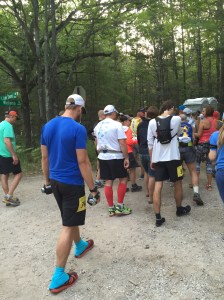
So, I finally ran a trail marathon this last July.  It was awesome and only took an hour longer than I planned.  I ran the first half in the time I planned, and then I added an hour on the second half.  If you are reading this blog for an account of awesomeness, I am afraid that I will disappoint you.  I am an apprentice to a servant, the Servant, and you would think that I would have learned a thing or two about humility and prayer after thirty years and not need this lesson, but you would be wrong.

Running is something I love.  I don’t suffer runs, even when I am suffering: I love them.  There is little to beat a long run on a sunny day in July along the North Country Trail through Wilderness and the Headlands parks.  So much of the run was on single track that I was shocked by how open two track places felt.

We took off at seven in the morning after camping at a campground with Amy and two of our children.  There are two things you really should know beyond that it is single track: you have to carry liquids with you in bottles or backpacks because it is more than four miles between water stops and the distances vary because of the remoteness of the trail; and for several miles we were warned that our GPS would be wrong due to the hilliness of the terrain, being along old sand dunes now covered in forest.  I lost my watch three miles from the end and should have just used the timer not the GPS, but there you go.

The run began along Wycamp Lake Road just north of Cross Village, Michigan, a few hours from home.  It began along a road that barely counts as one, as I got my parents SUV stuck showing them the road a week ago.  After a quarter mile to sort out who was where, we turned off onto the trail.

Trail running is different from road running a marathon.  In a road marathon, you find a rhythm and you drop into a zone almost like Transcendental Meditation.  It is peaceful and forces a wonderful patience and meditative state.  On trails, especially single track in hilly woods, you have to be constantly alert and mentally flexible.  It is more like Zen mind.  It is reflectively awake.  It is my home mental state.  It is the mind on fire; it is the mind at peace.

I love the dance of the trail like a tango with the earth.  It is sensuous and religious, like incense, chant, bodily sung, and wondrous.  It is so holy and languid.  I always think this, but returning to that state after twenty miles, after throwing up, after the sweating and the deer flies and fatigue.  That is the lover come home to the beloved.  It is an earthly experience of what prayer is like.

You know, if you have been reading along, that running is prayer for me.  I admit that I am not a great pray-er.  I read about the saints and heroes and heroines of the faith praying all night and years in the desert, their hours on their faces, on their knees, or armed outstretched. I read about them, and I hunger for God like that, but I fall asleep, I get distracted, I do the dishes, play solitaire, check messages, and fail.

Prayer demands more from me than running in a way.  It does not hurt the body so much, but it does hurt the ego, strain the mind’s attention, the heart’s priorities.  I can add up the miles on my feet, but the hours before God elude me.  So I run.

But I am learning that my prayer life needs the methodology of my body.  It took me seven years to run a seven minute mile; seven years to do a one-handed push up; seven years to get my deadlift-squat-benchpress total up to 900 lbs.  And none of those things remain as I cycle away from running, working out, lifting, to other priorities.  But prayer I need even more.

I need the patient accrual of prayers, of hours, of days, of weeks of prayer.

And sometimes, dear reader, I feel that lover-returned-to-the-Beloved dance of prayer.  It does not often go five hours, but it does go hours these days.  My prayer life like my running has become sensuous over the years, pleasurable, dancing in the way that only those who are mastering the thing find.

I do not think that I will ever be a competitive runner, but I may be a master runner because I know the realities, the subtleties, the love beyond the strain of the practice, the craft beyond the technique, and I can teach it.  O for prayer mastery!

For that I turn to Martin Thornton and the Daily Office, the disciplines and the joy of the long hours, the faithfulness I have to work so hard for now begins in little moments of inspiration to become something more, something like the joy of runner in the landscape who dances along the cosmos with the Creator of all things, born new and newly creative.

So I didn’t run as fast as I wanted, but O did I run!

IMG_0705

*The photos are from the beginning north of Cross Village and the end at the high school in Mackinaw City, Michigan.  It is hard to show the actual trail.

Trail Running with Benedict – Learning Humility part II

Trail Running with Benedict – Learning Humility part II

( part I is here.)

One of the amazing things about the Rule of Benedict that does not leap out at those who only glance at it, see it as obsolete, and flip past the last two-thirds of the book before putting it somewhere people will see it displayed prominently, is that the Rule is remarkably humane.

Benedict is constantly allowing for organic variability in the application of the Rule, either for the seasons of the year or at the discretion of the abbot.

In a world where we see both wild diversity and militaristic uniformity, it is remarkable how moderate the Rule is in asking for submission but encouraging allowances.

As a trail runner, I tend to fall down on the side of wild diversity. I like the constancy of change on natural ground and only tolerate the dull repetition of the road as necessary with excuses about it being meditative.

Humility is a personal discipline. Most of what we put in that category is not really personal because our lives are deeply communal. With a wife and children, my life is even more communal than before, and no decision is truly personal.

Humility, though, is a personal discipline that has an effect on everyone who encounters us, but it must be chosen personally. Humility cannot be forced or even really encouraged from outside of yourself.

Force someone to be humble, and you are destructive. Encourage humility, and you are a bully. Okay, that is a tad overstated. I sound like a social media zealot. But there is a truth involved. You may be able to encourage a child or a friend to look at themselves and even rarely call them out on the distance between their idea of themselves and reality, but there has to be enough love-capacity built up to pay the cost of such a charge.

No we have to choose humility, to face that distance between our hopes, ideals, and ideas and our reality, ourselves. We have to will ourselves to have peace beyond the anxiety such a facing calls up.

I am not an anxious person, and you may not be either, so let me walk you through what I mean. When I come face to face with some aspect of my real self, say, my arrogant assumptions about my running ability, this will bring up anxiety naturally. Because I have not merely thought of myself as a great runner, but chances are I expected to win races, run fast, and may have told others, I may have spent money and time on this assumption, I may have chosen to be with certain fast runners and eschew the company of slower runners. I have invested in a view of my self based on the assumptions of my abilities. Now, I lose a race or get injured or just have a slow period due to overtraining. I have to admit to my self that I am not as fast as I thought.

This alone does not seem so bad, but I will admit that I have struggled here. I build up excuses and pass around blame to avoid dealing with the truth. I reinforce the mask, which now terribly is revealed as a mask at some level. I defend my false self against revelation.

My failure is not merely about reimagining my own time goals. I will have to tell those who I told was fast, or to whom I acted fast, that I am not fast, that I lied or failed. I will have to mourn the loss of that invested time, energy, money. I will have to face the relationships that may no longer have value or that I turned away because of my arrogance.

If I know and value my self as a child of God who is loved for being, none of these things is a great burden, only a hurdle on the way. But if I only know my self as a fast runner whose value is in winning or success, then my interior view of my self is in real danger.

Does this seem touchy-feely? It is not. I have seen the violence done by people protecting an unnecessary view of themselves time and time again in person. I have seen the damage that I have done as I struggle with my ego.

I am not entirely comfortable identifying my proud self with ego. Freud did not help us with choosing this term to identify this part of us. Ego is from the Latin for “I.” According to Merriam-Webster, it is the part of the self in psychoanalytic theory that navigates between the self and the world. It is associated with pride and an antonym from humility.

But ego is not antithetical to humility. We need ego, the “I am” of the self in the world. We need to know that we exist and have value in our just being. I cannot say this enough. In a healthy Christian anthropology (theory of what it is to be a human being), we are created in love and are loved from our creation.

It is a crappy, degraded, pagan Christianity that begins with an evil God who hates us. It neither offers explanation for creation nor meets the teachings of Jesus about his Abba God who loves us. We are loved even as we fail.

Living out this kind of anthropology means that we make allowance for our organic humanity even as we call for our better selves in worship and living together. The Rule’s balance in this regard is remarkable.

My balance on the other hand is questionable. I constantly want to succeed. I have dreams and ideals for my self and my family and my church. I want to run as fast as that high school kid from downstate I was reading about. But I don’t. I eat a lot of pizza on pizza night with my family. Our attendance at church varies with the weather and the season. I stay late on normal days to get a little more done.

I lace up my shoes and head out. Everyday I vary. I need a Latin phrase for “I vary.” *Variaro ergo sum*.

I run with a Suunto GPS that tells me my pace, speed, elevation, heart rate, attractiveness, holiness, and actual location in the Rule of God. I want to be a little better than yesterday, than last week, than last year. But the truth is more complex, as Mr. Suunto likes to point out.

Last year I ran a ten mile loop in seventy minutes, this year I crashed out on the same run. I called Amy, who couldn’t come get me because she had the car to get the child I was supposed to pick up because I was going to be back in sixty-five minutes and it was now well over an hour and a half and I was walking still miles from home, wet, and shaking from the cold. It was the same run, only much colder, rainy, and I had neither eaten nor hydrated well. But even if I had, I was not in the same shape coming out of the winter rather than summer.

In the end, I am human, of the humous, of the earth, organic little ball of God-breathed dirt, but dirty none-the-less. I may fly or fall, but I am God’s to cheer or catch. I strive, and I crawl, but the long run always ends up in the same place. I will end up with God answering for how I loved the river clay, whether my own or my wife’s or my children’s or yours.

God loves me and expects me to love my own self and others with the same kind of love. It is that expectation that leads me to the demands of the trail and the Rule. It is that love carries me when I fall and that puts out my hand to my neighbor when he falls.

The other reason I love trail runners is the joy and camaraderie of the trail. It is different in my experience from the road. We know we can’t compete for the trail, only along it. It belongs to God and leads to home, no matter what trail it is.

So relax a little and turn off your GPS, be where you are right now, be who you are right now. Be humane to you. You are loved, you little failure, or you are nothing. Your existence is proof that you are. So relax and face up, you are only what you are.

You are a human being, and we vary, like the Rule, like the trail.

Trail Running with Benedict – Learning Humility

Trail Running with Benedict – Learning Humility
The quarter mile is kind of out of fashion. We run 400 meters races now, but in junior high school I became a quarter-miler.

It was a track meet against at our rival school’s track, that I first discovered a run that mattered. We were tied with East Holmes Academy, I was last leg in the mile relay. My faithless coach told me to run my own race and be content just as our rival team took a hand-off in the mile relay right behind our third leg. He kept the race close. We had a two foot lead as Doug handed me the baton, and I took off full speed. I was sprinting as I went around the first curve, and my older brother joined the coach in yelling for me to slow down.

*Slow down*? What kind of coaching was that? I was in first, and my name could have been Orville; I was discovering flight. I won. I really won and broke the school age record for the quarter-mile. I discovered that the race was a sprint and not a run, and I could sprint. All of those lonely miles in forests and fields had given me the endurance to run flat out for longer distances than others.

When we moved to Tennessee and Arizona I continued to run through a couple of minor football injuries and much bigger competition, and I won a few races. My senior year in Arizona, I was set up coming into track season to be one of the top five quarter milers in the state. I wasn’t going to win it all. I had realized that there were at least two runners with a whole set of gears beyond mine, but I was the best at Ironwood High School, team captain, and secure that I would be going to State with a shot at placing.

I started the season with a mildly sore achilles tendon, so coach wanted me to run an easy race in a small meet on our track, loose dirt, to set a time for the next major meet coming up a week later. I was supposed to come out easy and set up for a strong finish, maybe a 80% effort.

Coming off the first corner, I was first and shifted from the forward-lean of a true sprint to a laid-back long-reaching stride I had used the last two years when I felt a Charlie Horse in my right hamstring. As the muscle knotted up, the natural kick forward of each stride pulled the knot apart. I could feel my hamstring tearing, and I went down on the side of the track for the last time as a competitive runner. I cursed. I yelled at the trainer.

I had torn my right hamstring. A doctor explained that I had torn three of the four major muscles of the hamstring at 75, 80, and 40%. I was given cutting edge treatment, but we never considered surgery. My running career was over.

It was a humbling experience. I don’t mean that I was some sort of Icarus flying too close to the sun. I wasn’t overly puffed up with pride. I wasn’t some punk kid. I was a team captain and a Christian who had given my life to ministry for Jesus the summer before. I thought of others. I led warm-ups and stretching and prayers at school and church. I worked with younger runners.

No, it was humbling because I got re-planted in the earth, reconnected with my ground of being. I look back now at that high school kid and see the way I would come off the track with my head pounding and my muscles complaining and my focus on myself. I see the weakness at the core that I never addressed despite my coaches admonitions, and the terrible form that I had deduced from bad logic and led to my over-reaching stride. I see the brokennesses that would become patterns, habits, addictions in later adulthood. But it is not really humility to see your weaknesses only and name them. Humility is being grounded in a knowledge, an ethic, a life that is bigger than your own capacity. It is giving up the will to self.

As for self-will,
we are forbidden to do our own will
by the Scripture, which says to us,
“Turn away from your own will” (Eccles. 18:30),
and likewise by the prayer in which we ask God
that His will be done in us.
And rightly are we taught not to do our own will
when we take heed to the warning of Scripture:
“There are ways which seem right,
but the ends of them plunge into the depths of hell” (Prov. 16:25);
and also when we tremble at what is said of the careless:
“They are corrupt and have become abominable in their will.”
from Chapter 7 of the Rule of Benedict, osb.org

Self-will moves us away from humility. When I discovered that I knew better what I was capable of than my coaches, that was a truth, but it was also a seed of arrogance that would grow like a vine in me, setting roots into the mortar of my character, and eroding my very foundation. I could see my strengths clearly, but I was unaware of the seriousness of my weaknesses.

How do we turn away from self-will? Submission. How do we begin to truly learn from others? Submission. How do we become a part of something larger than ourselves? Submission.

Now submission is not popular. We think of submission as something forced on someone else, but submission is the willing giving up of our self-will to another.

Seven years after my high school track career destroyed my hamstring, I started to rebuild it (and the rest of my self) when I submitted my physical life to the teachings of a Hindu guru named Swami Sivananda. Someone had given a complete set of his books in English to the graduate school library, and I found them looking up Bede Griffiths for a model of ecumenism.

My life was in shambles as I studied to become a priest in the church. It was clear that I had no idea how to take care of myself, so I just did was the Swami said about practicing yoga, breathing, walking, and eating. I gave up my will to those little battered paperbacks. I ate simply and did yoga daily for six months. I lost well over fifty pounds and got my mind back together.

The irony is that I am not and was not Hindu. Submission is what I needed, and I was so broken down that almost any truth applied consistently was bound to do some good. The Swami was really wise and good for me, and I still apply some of his teachings. But he also gave me back the Ten Commandments, not as rules but as precepts, taking them from a set of laws to be kept or broken to being a way of life that flows directly into Jesus’ Beatitudes in ways I had not seen before.

“Blessed are the poor in spirit, for theirs is the kingdom of heaven” Matthew 5:3.

Humility leads to blessedness. Submission is one of the keys to humility, according to the Gospels and to Saint Benedict.

If I had submitted to my track coaches twenty-five years ago, I would not have been injured. Even just strengthening my core would have been enough. But if I had really submitted in learning running form and only going out at 80%, I would have finished my senior year running and set myself up for a much less heavy college career.

Submission is giving up our self-will to the will of another. Now I still have plenty of self-will left. I am still getting grounded year by year. I still get self-focussed when my blood gets to pounding and my efforts are over-reaching my capacity.

Running helps. When I started to run again seriously in my late twenties, I submitted to a running plan from a beginner’s book and running form from Danny Dreyer’s book *Chi Running*. I started over and stopped exalting myself.

From there I actually grew and today I am stronger and more healthy than I have ever been. By exalting my own ideas about myself and my running, I destroyed my running career. By humbling myself I have learned how to be really strong and to keep running safely year after year.

Today I stay grounded by submitting to running plans and workouts from actual experts, the coaches of adult life. I submit to my wife and to my bishop. I submit to committees and boards, to the community at the church where I serve, to my true guru Jesus of Nazareth, and to God’s dream in the Scriptures.

Submission has its balance of course. This is not a plea for some sort of Masochism or weird sexual practices. I think abuse is just abuse.

Humility is grounded in truth. I am humble enough to know my weaknesses, but I am also humble enough to know my strengths honestly and use them mostly without arrogance. I am humble enough to know the value that I have as God’s child in Christ and defend my dignity with love as I do others. You must not tolerate self-destruction in Christ anymore than destruction of others.

So I am a mid-pack runner these days, when I (very rarely) run with a pack. I still have a visible gap in my right hamstring after all these years. And every spring I get the itch to run in circles until I fall over.

I am not a great runner, but I still love to fly. There is a moment that I love on long runs when the trail pitches over narrow ridges or along the close hug of the forest when my feet go sailing behind me with the wind on my face and my body floating over the good earth, and I toss myself into the care of God.

Ultimately I submit to others because in doing so I submit to God. And I submit to God because I have come to know that God always catches me up into a web of love that, when I trust it, keeps me on my feet, limping and sailing along the Way through fields of gold where the wheat bends bowing in the winds of the Spirit.

That harvest that will someday feed the world is my hope. I submit because I know that God is able to do more than I can and often with those I don’t suspect of belonging to Christ. God’s dream has always been carried by those who like Abraham and Mary and Benedict submit to God’s will. Greatness in winning races is nothing compared to that belonging found when someone bows to you to wash your trail-worn feet or you wash theirs and find between you that doorway home into the Household of God.

Trail Running with Benedict — On Belonging

My life is a long conversation about God over beer and coffee.  I have said this for a couple of decades.  But the real soundtrack of my faith is not the chatter of conversation or the clatter of computer keys;  it is the tap-tap-tap of feet against dirt.  My faith is really shaped by the miles alone along the trails.  This is not how I instinctively think of my faith, or other people’s faith.  I think in terms of communities, belonging, traditions.

One of the first arguments Amy and I had after getting married happened when I exploded when she told me she did not attend coffee hour after church.  I mean, I calmly explained that was where community was formed and friendships born.  We belong because of coffee hour, I quietly expressed.  As the vicar of a small church, I was reading my own pastoral concerns into the conversation.  Churches need community.  Coffee hour = Community.

Community is one of those words we use without knowing exactly what we mean, but sure that we hunger for something under that label.  As a pastor, what do I mean by community?  I mean something like the friendship of the group.  It is more than a pile of individual friendships.  You can find Webster’s definition here. It is amorphous and broad.  I think I mean the unified part, but I think about the emotional connotations of unity rather than the spiritual or civil implications.

Does it matter how we feel about our church as a community?  Feelings have been idolized in many ways in our culture.  Feelings trump the Bible, rational thought, spiritual insight, truth, love, good will, facts.  Feelings are not facts. I could go on and on, and I have.  Ask my kids.  But on the other hand, our feelings do matter.  But I wonder what it would look like to think about community beyond my feelings.

Feelings are the weather of the human ecosystem.  They are temporary, shifting, different in different people, seasons, times today.  They are responsive to all sorts of things, including internal and external factors, hormones and horrible bosses.  Their temporal nature does not make them less powerful though.  Emotions can erode the strongest intentions and commitments.  Emotions can come to define the human being as surely as desert mountains differ from northern forests.

Who we are as human beings is tied deeply to our emotions.  But at the same time, our emotions are fickle.  So when it comes to community, emotions are vital and quickly elevated to Creator status.  Genesis would be a different book if after creating the world God said, “I feel like this is good.”  The opposite of feelings in community work is not facts.  Facts are a parallel element of community, along with intentions, leadership, vision, communication structures.  The opposite of feelings is emptiness, the death of the community.

Maybe.  That brings up one of the fundamental questions, right?  Is community ephemeral?  Webster’s reminds us that community is association defined by a lot of things, where you live, citizenship, location, common policy.  If I lock ten people in the room, are they then a community?  Not the way we connote the meaning of the word.  On the other hand, I live in a neighborhood that it is an unconscious community.

This brings me back to the church.  We are in the middle of these little plate conversations about the church, and one of the issues that gets served right up is the issue of membership.  We have probably 30% to 40% of our active church community that does not belong to the Episcopal Church, and therefore not to our congregation.  (Remember, wonks, that a parish is a geographical area of ministry.)  They are in Benedict’s Rule visiting pilgrims.  I want them to join, but they hold on to old affiliations, or sometimes to no affiliation at all, other than Christian.

We are clear about who we are and what defines our branch of the church.  I cannot even say “our church” anymore because our disciples are willing to kick back that “church” means the “one holy catholic and apostolic church” of the creeds.  But many people do not want to join.

Membership.  They would join Grace Church, or think they have joined Grace despite all he announcements and explanations, articles and declarations.  But, they are not interested in joining the Episcopal Church, or any particular denomination.  Now I am probable to blame on a lot of levels.  But much of this is deeply felt cultural trends.  It is also feelings.  They feel like they are a part of something real at Grace Church.  But they don’t feel any association with the denomination or the diocese.  Or they just refuse to define themselves out of the “one holy catholic and apostolic church.”

It is sometimes the politics of our national church, social issues, family affiliation, sectarianism as a rule, the particulars or a particular of the tradition.  It is is also a lack of awareness of what it means to belong.  And because our welcome is so good, and yes it is so good, except for sometimes, that many people see no reason to join officially.  When the table is open to everyone, what benefit is left?  What is the benefit of moving my membership or dumping my old denomination if I can come and receive here and be welcomed.

So I am thinking of just cutting out all that crap and putting up a turnstile with membership cards.

Okay, not really.  But I am constantly aware that for many people who come into the shallow ends of the mainline river, the primary thing they are hungry for is communion, second is community.  And if they can get the feeling of community and a good piece of bread, they have everything they need for community.  But I am convinced that they are wrong.

I just don’t know how to convince people that the real benefit of belonging is the way we run in the wilderness.  It is the pattern, the method, the training in the way of life that is the real benefit of our branch of the church.  Our local training club is pretty freaking awesome and the get-togethers are fantastic.  Sure, the coach is a doofus.  But this is where we learn to run.

Because who we really are and what we are really about is the miles on the trail.  It is the running often done alone.  This congregation is really a running club in disguise.  We get together, we run in groups, we train, we have coaches, we offer each other support, maps, rides, and companionship.  But the runs, the runs are what we are about, out there alone on the trails, taking the gospel out, finding the lost and bringing them home, talking Christ to the wanderer, water to the thirsty, food to the hungry, peace to the warring, and forgiveness to all.

We live most of our lives outside the club.  We do most of our running in between the group runs, on trails the group mostly never sees.  But because we belong to the club, we never really run alone.  We have someone to call, a lot of someones, when the miles add up to more than we can handle, or the darkness needs more light than we can bear alone.

We take in pilgrim runners, it is true.  We don’t all wear the same shirts and shorts, though I often dream of a uniform for the church.  We give too freely away what is a result and not a product.

Maybe there is the confusion.  Communion is a result of community with God and with each other.  It is the outcome of the miles, but because we hold it in this physical symbol, it is confused to be a product, something received.  And so there seems to be no cost more than showing up.  We may know otherwise, but how it feels throws us off the trail.

So what do we do with these pilgrim believers? I am not sure that we have a choice but to run with them.  We have to encourage them to join, to explain the club and its usefulness, its purpose, its belonging, but our deep calling is to run and run together bearing the light of Christ, sharing the light of Christ freely.

It just means our running club is always struggling when we are doing our job well.

So run, put in the miles.  The pitter-pat tapping of feet on pavement and trail is the hymn of the runner, the praise of the human being alive, taking the Gospel out of the club that has it (sort of) and into the world that needs it.  That Gospel is that God loves us, provides and protects us, wants to go with us and us with God into the vistas of Grace where people are lost and lonely, hurting and hungry, where we discover that the Spirit has already been here and that when we love the best, we are the dirtiest, covered in the dust of our rabbi Jesus.

Join in.  Come in from the streets and trails of your journey and break bread with us, sing with us, and be refreshed.  Pardon us when we celebrate our club too much, try to get you into a uniform, or pitch membership.  We just love what we are doing and want you with us.  We believe that this work of being a branch is important, providing rest support to the runners, coaching and opportunities to run together, training and easy places to try your feet out, and collected wisdom of a community that is not only broad but deep, millennia-old and dusty in the right way.

Chapter 61: How Pilgrim Monks Are To Be Received

Apr. 15 – Aug. 15 – Dec. 15

If a pilgrim monastic coming from a distant region
wants to live as a guest of the monastery,
let her be received for as long a time as she desires,
provided she is content
with the customs of the place as she finds them
and does not disturb the monastery by superfluous demands,
but is simply content with what she finds.
If, however, she censures or points out anything reasonably
and with the humility of charity,
let the Abbess consider prudently
whether perhaps it was for that very purpose
that the Lord sent her.

If afterwards she should want to bind herself to stability,
her wish should not be denied her,
especially since there has been opportunity
during her stay as a guest
to discover her character.

But if as a guest she was found exacting or prone to vice,

not only should she be denied membership in the community,

but she should even be politely requested to leave,
lest others be corrupted by her evil life.

If, however, she has not proved to be the kind
who deserves to be put out,
she should not only on her own application be received
as a member of the community,
but she should even be persuaded to stay,
that the others may be instructed by her example,
and because in every place it is the same Lord who is served,
the same King for whom the battle is fought.